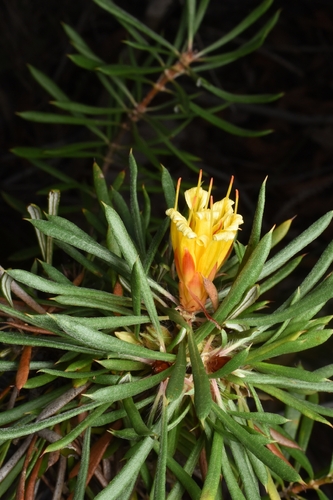
Fairall's Lambertia
Lambertia fairallii
Photo: Photo: (c) Bryce van der Heide, some rights reserved (CC BY-NC), uploaded by Bryce van der Heide
Overview
Fairall's Lambertia is a woody shrub in the family Proteaceae, a group known for its stiff, leathery foliage and distinctive flower structures. Like other members of its genus, it likely produces tubular, honeysuckle-like flower clusters that attract nectar-feeding insects and birds, which serve as pollinators. Its fruit forms in hardened, woody follicles typical of many Proteaceae, an adaptation that allows seed to be stored on the plant and released after disturbance.
Within its ecosystem, the species contributes to the structural diversity of the shrub layer and provides a nectar resource for local fauna.
The species is restricted to Australia, where it occurs in forest, shrubland, and rocky habitats. Its range appears narrow and localized, consistent with its critically endangered status.
The primary documented threat to Fairall's Lambertia is fire, both from altered fire regimes and from fire suppression practices. Proteaceae species in fire-prone Australian ecosystems often depend on specific fire intervals for seed release and regeneration; both overly frequent burning and long-term fire exclusion can disrupt these cycles, reducing recruitment and gradually shrinking populations. Given its restricted distribution, the species has limited capacity to buffer against such disturbances.
Conservation attention for this species centers on monitoring population status and habitat condition, alongside broader efforts by Australian land management agencies to develop fire regimes that support the persistence of fire-sensitive flora within Proteaceae-rich communities.
The population trend is currently decreasing, and the species remains classified as Critically Endangered. Without management interventions that address fire frequency and habitat protection, its outlook remains precarious, reflecting the vulnerability typical of narrow-range Proteaceae species in fire-dependent ecosystems.
Fairall's Lambertia is mainly threatened by fire, including both wildfires and the way fire patterns are managed in its habitat. Changes to natural fire cycles—such as fires occurring too often or at the wrong times—can prevent the plant from properly regenerating and reduce its populations over time. This threat is ongoing and appears to be stable rather than clearly worsening or improving.
Habitat
Conservation measures underway
Other threatened species in PROTEACEAE
Threatened in Australia
Frequently asked questions
Why is Fairall's Lambertia classified as Critically Endangered?
Where does Fairall's Lambertia live?
What are the main threats to Fairall's Lambertia?
Get weekly conservation intelligence
One short digest a week of the most striking species and country data we ship, plus breaking conservation news paired with our database where it matters.
Free, no spam. One-click unsubscribe in every email.