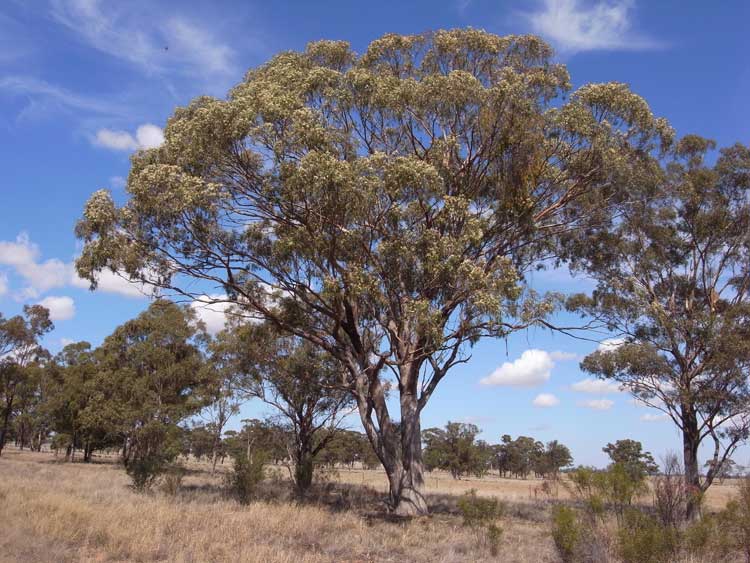
Eucalyptus woollsiana
Photo: Wikimedia Commons (CC) via https://en.wikipedia.org/wiki/Eucalyptus_woollsiana
Overview
Eucalyptus woollsiana is a tree in the family Myrtaceae, part of the broader eucalypt group that dominates much of Australia's woody vegetation. Like other members of the genus, it produces hard, fibrous or fibrous-flaky bark, elongated evergreen leaves rich in aromatic oils, and clusters of small flowers with numerous stamens that yield woody capsular fruits. These flowers provide nectar and pollen resources for insects, birds, and small mammals, while the tree's canopy and leaf litter contribute structure and organic matter to the forest ecosystems it inhabits.
The species is restricted to Australia, where it occurs within forest habitat. Its distribution is limited, a factor contributing to its conservation concern despite a currently stable population trend.
The primary threats to Eucalyptus woollsiana stem from land-use change associated with agriculture. Clearing and conversion of land for annual and perennial non-timber crops reduces and fragments the forest habitat this species depends on. Livestock farming and ranching add further pressure, through habitat degradation, soil compaction, and suppression of seedling regeneration by grazing animals, which can prevent young trees from replacing older ones lost to clearing or natural attrition.
Specific targeted conservation programs for this species are not well documented, but as with many threatened Australian eucalypts, protection likely depends on the retention of remnant forest patches, regulation of land clearing, and management of grazing pressure within its range. Broader Australian conservation frameworks, including reserve systems and native vegetation protection laws, may offer some indirect protection.
The species is currently classified as Endangered. While its population trend is stable, ongoing agricultural and grazing pressures mean its long-term persistence depends on continued habitat protection and management within its restricted Australian range.
Eucalyptus woollsiana is primarily threatened by land being cleared or converted for growing crops, as well as its habitat being used for livestock grazing and ranching. Both of these pressures are currently ongoing, meaning the tree's natural habitat continues to be lost or degraded to make way for farming activities. Based on the continued and active nature of these threats, the pressure on this species appears to be stable rather than decreasing.
Habitat
Conservation measures underway
Other threatened species in MYRTACEAE
Threatened in Australia
Frequently asked questions
Why is Eucalyptus woollsiana classified as Endangered?
Where does Eucalyptus woollsiana live?
What are the main threats to Eucalyptus woollsiana?
Get weekly conservation intelligence
One short digest a week of the most striking species and country data we ship, plus breaking conservation news paired with our database where it matters.
Free, no spam. One-click unsubscribe in every email.