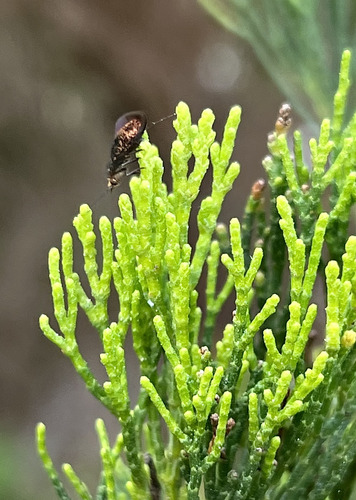
Enigma Moth
Aenigmatinea glatzella
Photo: Photo: (c) daymoth, some rights reserved (CC BY-NC), uploaded by daymoth
Overview
Aenigmatinea glatzella is a small moth notable for its metallic gold-and-purple forewings and its taxonomic distinction — it is the sole known member of family Aenigmatineidae, a lineage recognized as one of the most primitive groups within the order Lepidoptera. Adults are day-flying and possess functional mandibles, a primitive feature linking them to ancestral moth lineages that predate the evolution of the coiled proboscis seen in most modern moths. As with other primitive Lepidoptera, larvae are presumed to feed on mosses or similar low-growing vegetation, contributing to nutrient cycling in the leaf litter and moss layer of their habitat.
The species is known only from a limited area of coastal Kangaroo Island, South Australia, where it inhabits marine coastal and supratidal vegetation. Its known range is highly restricted, and no populations have been confirmed elsewhere.
Its critically endangered status stems from the narrow extent of its habitat and its vulnerability to disturbance. Ongoing threats include altered fire regimes and fire suppression practices that change vegetation structure, broader habitat shifting linked to environmental change, encroachment from housing and urban development, and logging and wood harvesting activities that degrade the coastal vegetation the species depends on.
Conservation attention has focused on habitat protection within its known range and continued monitoring to better understand its distribution, life cycle, and larval host plants, given how recently the species was described and how little is documented about its biology.
The population is currently assessed as stable, though it remains confined to a very small range with multiple ongoing pressures. Its long-term outlook depends on the continued integrity of its limited coastal habitat.
The Enigma Moth faces ongoing pressure from wildfires and the way fire is managed in its habitat, along with broader shifts and changes to its natural environment. The clearing of land for housing and urban development, as well as logging and wood harvesting, are also reducing and altering the habitat this moth depends on. All of these threats are currently ongoing, suggesting a stable but continuing level of pressure rather than a clear increase or decrease.
Habitat
Threatened in Australia
Frequently asked questions
Why is Enigma Moth classified as Critically Endangered?
Where does Enigma Moth live?
What are the main threats to Enigma Moth?
Get weekly conservation intelligence
One short digest a week of the most striking species and country data we ship, plus breaking conservation news paired with our database where it matters.
Free, no spam. One-click unsubscribe in every email.