
Pteroglossus bitorquatus
Local name: Eastern Red-necked Araçari
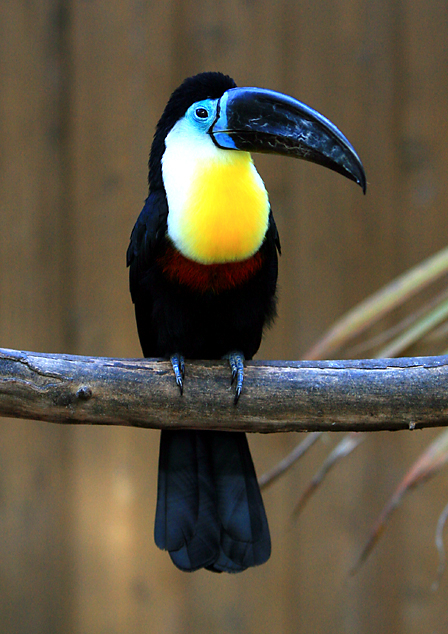
Photo: Wikimedia Commons (CC) via https://en.wikipedia.org/wiki/Red-necked_aracari
Overview
The red-necked aracari or red-necked araçari is a near-passerine bird in the toucan family Ramphastidae. It is found in Bolivia and Brazil.
The Eastern Red-necked Araçari faces severe population declines primarily due to extensive deforestation and habitat fragmentation across its range in the Amazon Basin. Agricultural expansion, logging, and infrastructure development have significantly reduced and isolated remaining forest patches, while the species' dependence on large fruiting trees makes it particularly vulnerable to selective logging practices.
Habitat
The subspecies of red-necked aracari are found thus:
* P. b. sturmii, north-central Brazil south of the Amazon River between the Rio Madeira and Rio Tapajós, south from there to Rondônia state and eastern Bolivia, and east to near the Rio Xingu * P. b. reichenowi, Brazil south of the Amazon between the Rio Tapajós and Rio Tocantins and south from there to northern Mato Grosso * P. b....
Other threatened species in Ramphastidae



Frequently asked questions
Why is Eastern Red-necked Araçari classified as Endangered?
Where does Eastern Red-necked Araçari live?
What are the main threats to Eastern Red-necked Araçari?
Get weekly conservation intelligence
One short digest a week of the most striking species and country data we ship, plus breaking conservation news paired with our database where it matters.
Free, no spam. One-click unsubscribe in every email.