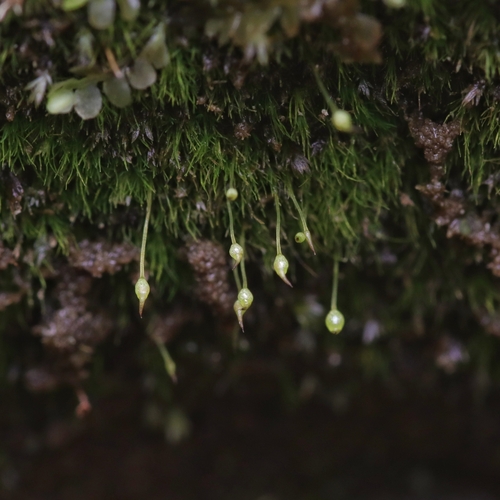
Dwarf Rock-bristle
VUVulnerable

Dwarf Rock-bristle

Seligeria pusilla

Dwarf Rock-bristle (Seligeria pusilla) is a tiny acrocarpous moss species that forms small, inconspicuous cushions or scattered shoots on rock surfaces. This diminutive bryophyte has narrow, bristle-like leaves and produces small capsules on short setae, playing an important role in pioneer plant communities on bare rock substrates and contributing to initial soil formation processes.

Photo: iNaturalist: (c) Johannes Merz, some rights reserved (CC BY-NC-ND), uploaded by Johannes Merz

01Classification

Taxonomy & Classification

Kingdom

Plantae

Phylum

Bryophyta

Class

Bryopsida

Order

Grimmiales

Family

Seligeriaceae

Genus

Seligeria

Dwarf Rock-bristle belongs to the family Seligeriaceae, order Grimmiales, within the Bryopsida class.

02Description

Species Profile

Dwarf Rock-bristle (Seligeria pusilla) is a tiny acrocarpous moss species that forms small, inconspicuous cushions or scattered shoots on rock surfaces. This diminutive bryophyte has narrow, bristle-like leaves and produces small capsules on short setae, playing an important role in pioneer plant communities on bare rock substrates and contributing to initial soil formation processes.

Dwarf Rock-bristle faces significant threats from habitat degradation and loss of suitable rock substrates due to quarrying, construction activities, and air pollution. Its highly specialized habitat requirements and small population sizes make it particularly vulnerable to environmental changes and human disturbances in rocky environments.

Key Facts

IUCN StatusVulnerable (VU)
GroupPlants
03Habitat

Habitat & Distribution

Dwarf Rock-bristle grows on acidic rock surfaces, particularly sandstone and granite outcrops, walls, and rocky crevices in upland areas. It typically occurs in shaded or semi-shaded locations where moisture levels remain relatively stable.

04Threats

Threats

Air pollution and acid deposition

HighOngoing

Quarrying and rock extraction

HighOngoing

Climate change affecting moisture regimes

MediumOngoing

Construction and urban development

MediumOngoing

Recreational activities and trampling

LowOngoing
07National Status

National vs Global Threat Status

How this species is assessed at the national level compared to its IUCN global status (VU).

CountryNational StatusGlobal StatusComparison
EULCLeast ConcernVUVulnerableLower local risk

National Red List data sourced from the National Red List Project (nationalredlist.org, ZSL) and country-specific Red List authorities.

Community

Community Sightings

Report a sighting

No community sightings yet. Be the first to report!

07Sources

Sources & Attribution

How to Cite

IUCN: IUCN (2025). The IUCN Red List of Threatened Species. Version 2025-1. Available at: https://www.iucnredlist.org. doi:10.2305/IUCN.UK.2025-1.RLTS

GBIF: GBIF.org (2025). GBIF Home Page. Available at: https://www.gbif.org

National Red Lists: ZSL (2025). National Red List. Zoological Society of London. Available at: https://www.nationalredlist.org

This page: SpeciesRadar (2025). Dwarf Rock-bristle (Seligeria pusilla). SpeciesRadar: Intelligence for Earth's Biodiversity. Available at: https://speciesradar.org/species/dwarf-rock-bristle

Full citation guide & data usage terms