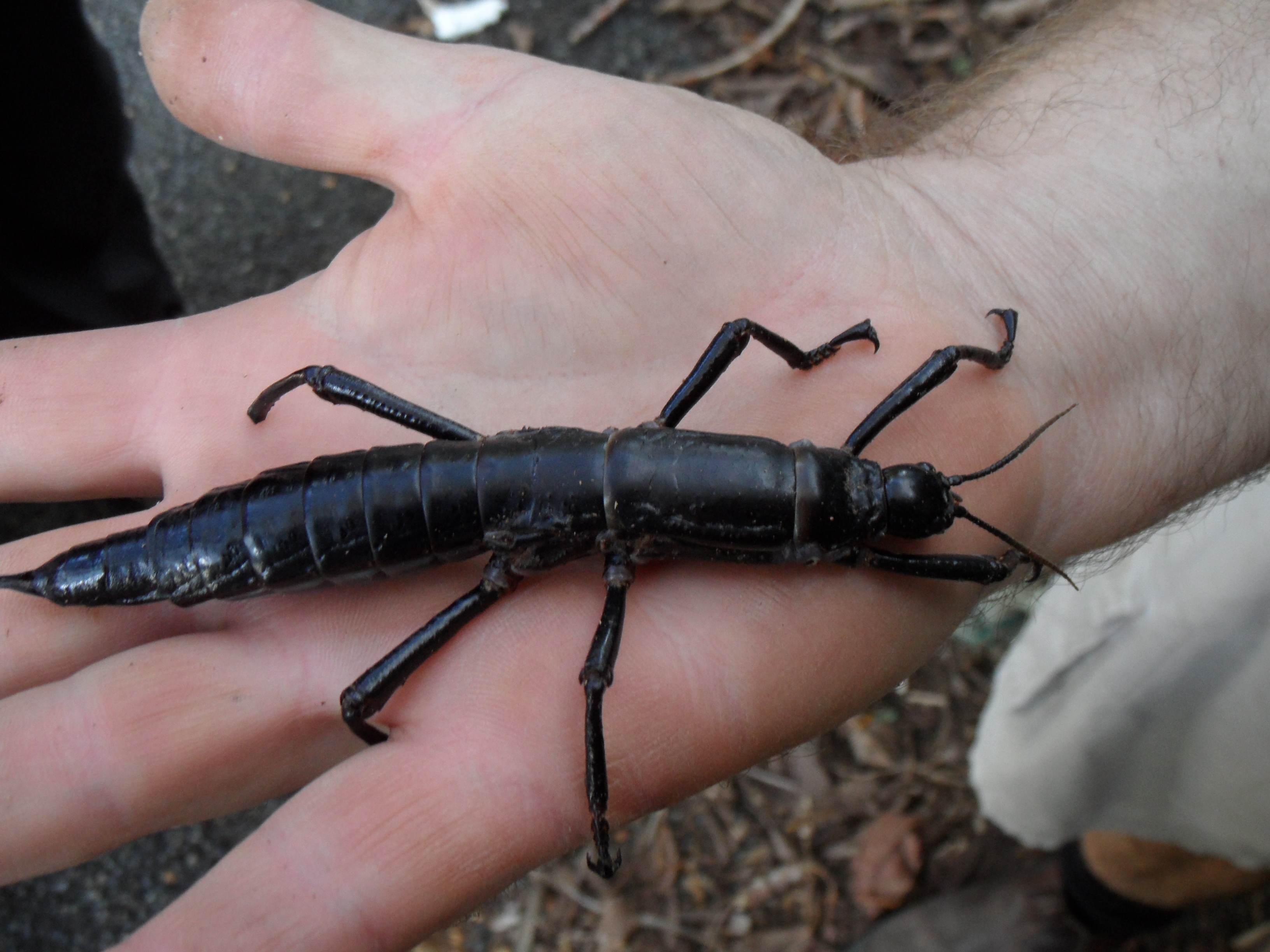
Lord Howe Island Stick-insect
Dryococelus australis
Photo: Photo: Wikimedia Commons, CC BY-SA
Overview
Once considered extinct, this large, flightless insect is one of the heaviest of its order, with a robust black-brown exoskeleton and a body that can exceed 10 centimeters in length. Nocturnal and largely herbivorous, it feeds on native vegetation and shelters in groups during the day, historically playing a role in nutrient cycling and as prey within its island ecosystem. Adults are wingless and rely on climbing and crevice-dwelling behavior for protection.
The species is endemic to the Lord Howe Island group off the coast of Australia. Once found across Lord Howe Island itself, it was believed extinct for decades until a small population was discovered on the nearby volcanic outcrop of Ball's Pyramid, a habitat of steep rock faces with sparse vegetation, far more limited and marginal than its original range.
Its decline followed the introduction of black rats to Lord Howe Island in the early 20th century, which preyed heavily on the insect and eliminated it from the main island. The surviving population on Ball's Pyramid remains extremely small and geographically confined, making it vulnerable to genetic bottlenecking, stochastic events, storms, and any future incursion of invasive predators. Habitat quality on the outcrop is also limited.
Conservation efforts have included captive breeding programs established from individuals collected on Ball's Pyramid, with insectariums and zoos internationally maintaining assurance populations. Rat eradication programs on Lord Howe Island have been undertaken to enable eventual reintroduction to the species' historic range.
The species' survival currently depends on continued captive breeding success and the effectiveness of invasive species control on Lord Howe Island. Its long-term outlook remains uncertain, contingent on establishing self-sustaining wild populations beyond the single fragile site at Ball's Pyramid.
The Lord Howe Island Stick-insect's biggest danger is predation by invasive black rats, which were accidentally introduced to its habitat. Because the entire species survives in only one tiny, isolated location with very few individuals, it's extremely vulnerable to extinction from a single disaster, disease outbreak, severe storm, or the effects of climate change and rising seas. These threats show no sign of easing, as the species remains confined to a single vulnerable site with ongoing risks from invasive predators and environmental changes.
Habitat
Originally inhabited the forests of Lord Howe Island, feeding on native vegetation including Melaleuca howeana. The surviving population exists on Ball's Pyramid, a 562-meter tall volcanic stack, where they shelter under a single Melaleuca shrub and feed on its leaves.
Conservation measures underway
Other threatened species in PHASMATIDAE
Threatened in Australia
Frequently asked questions
Why is Lord Howe Island Stick-insect classified as Critically Endangered?
Where does Lord Howe Island Stick-insect live?
What are the main threats to Lord Howe Island Stick-insect?
Get weekly conservation intelligence
One short digest a week of the most striking species and country data we ship, plus breaking conservation news paired with our database where it matters.
Free, no spam. One-click unsubscribe in every email.