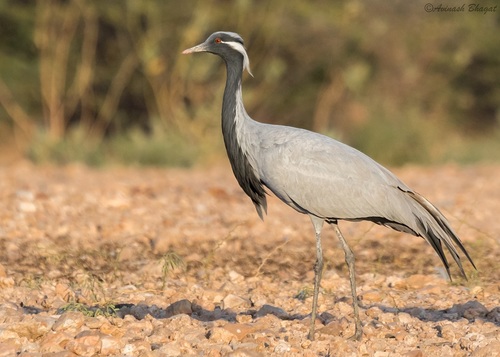
Demoiselle Crane
Anthropoides virgo
Photo: iNaturalist: (c) Avinash Bhagat, some rights reserved (CC BY-NC), uploaded by Avinash Bhagat
Overview
Demoiselle Crane (Anthropoides virgo)
The Demoiselle Crane is the world's smallest crane species, standing 85-100 cm tall with a wingspan reaching 165-185 cm. Distinguished by its blue-grey plumage, black neck and breast, and distinctive white ear tufts behind red eyes, this elegant bird performs elaborate courtship dances involving leaping, bowing, and calling. As omnivores, they consume seeds, insects, and small vertebrates, playing important roles in seed dispersal and pest control within their ecosystems.
These cranes inhabit grasslands, agricultural areas, and semi-arid steppes across a vast range from Eastern Europe through Central Asia to Mongolia and northern China. They breed primarily in Kazakhstan, Mongolia, Russia, and parts of Turkey, undertaking remarkable migrations to wintering grounds in India, with some populations traveling over the Himalayas at altitudes exceeding 8,000 meters.
Primary threats include habitat loss from agricultural intensification and infrastructure development along migration routes. Collision with power lines during migration causes significant mortality, while disturbance at roosting and feeding sites disrupts their energy-intensive journeys. Climate change affects the timing of migration and availability of suitable stopover sites.
Conservation efforts focus on protecting key breeding and wintering habitats, particularly in India's Rajasthan state where large numbers congregate. International cooperation through flyway initiatives coordinates protection across range states. Power line marking and rerouting programs aim to reduce collision mortality, while community-based conservation engages local populations in protection efforts.
Despite their extensive range, Demoiselle Cranes face mounting pressure from habitat fragmentation and human encroachment. Their dependence on specific migration corridors makes them particularly vulnerable to landscape changes, requiring continued international conservation coordination.
Demoiselle Cranes face severe population declines primarily due to habitat loss from agricultural expansion and water diversion in their breeding and wintering grounds. Additional pressures include hunting along migration routes, disturbance at roosting sites, and climate change affecting water availability in their arid and semi-arid habitats.
Habitat
Threatened in Afghanistan

Frequently asked questions
Why is Demoiselle Crane classified as Endangered?
Where does Demoiselle Crane live?
What are the main threats to Demoiselle Crane?
Get weekly conservation intelligence
One short digest a week of the most striking species and country data we ship, plus breaking conservation news paired with our database where it matters.
Free, no spam. One-click unsubscribe in every email.