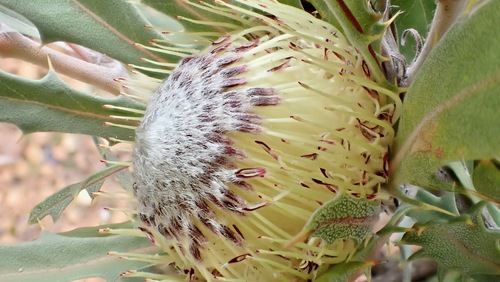
Dark-bract Banksia
Banksia fuscobractea
Photo: Photo: (c) Justin, some rights reserved (CC BY-NC), uploaded by Justin
Overview
This woody shrub in the family Proteaceae is characterized by the stiff, serrated foliage and dense, cylindrical flower spikes typical of the genus Banksia, with dark-hued floral bracts distinguishing this species from close relatives. Like other banksias, it produces nectar-rich inflorescences that attract birds, mammals, and insects, making it a valuable pollinator resource within its shrubland community. Following flowering, it forms woody follicles that retain seed until triggered to release, often by fire, a regeneration strategy adapted to the fire-prone ecosystems it inhabits.
The species is endemic to Australia, restricted to shrubland habitat within a limited geographic range. Its survival depends on the persistence of intact native vegetation, and its distribution appears to be patchy and localized rather than continuous.
Its Critically Endangered status reflects a combination of pressures. Livestock farming and ranching have degraded and fragmented native shrubland through grazing and land conversion. Road and railroad infrastructure has further fragmented remaining populations, restricting gene flow and increasing edge effects.
The expansion of annual and perennial non-timber cropping has consumed additional habitat. Compounding these pressures, problematic native species or diseases, potentially including dieback pathogens common among Proteaceae in Australia, threaten the health of remaining individuals.
Conservation responses typical for threatened Western Australian and Australian shrubland flora include habitat protection efforts, monitoring of remaining populations, and disease management aimed at limiting pathogen spread. Specific population figures are not established.
The population trend is decreasing, and the combination of ongoing habitat loss, fragmentation, and disease pressure suggests continued vulnerability without sustained intervention to protect and connect remaining habitat.
Dark-bract Banksia is mainly threatened by land being cleared or altered for livestock grazing and farming, as well as ongoing crop cultivation nearby. Road and rail construction also fragments and damages its habitat, while naturally occurring plant diseases or pest species pose an additional risk to surviving populations. These pressures appear to be ongoing and stable rather than clearly worsening or improving.
Habitat
Conservation measures underway
Other threatened species in PROTEACEAE
Threatened in Australia
Frequently asked questions
Why is Dark-bract Banksia classified as Critically Endangered?
Where does Dark-bract Banksia live?
What are the main threats to Dark-bract Banksia?
Get weekly conservation intelligence
One short digest a week of the most striking species and country data we ship, plus breaking conservation news paired with our database where it matters.
Free, no spam. One-click unsubscribe in every email.