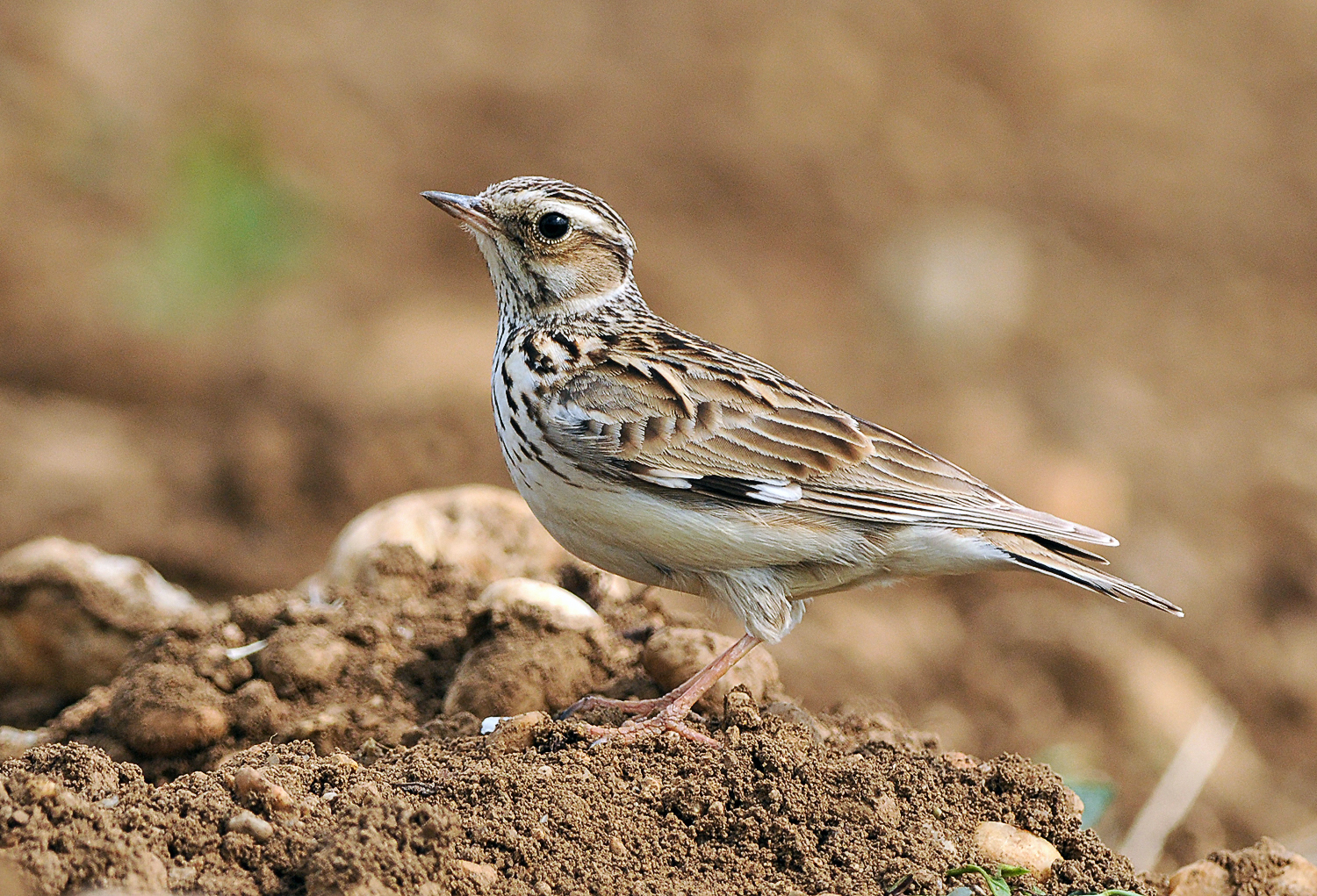
Crested Lark
CR

Crested Lark

Galerida cristata

UnknownNTNPLCEULCEU

Photo: Wikimedia Commons (CC) via https://en.wikipedia.org/wiki/Crested_lark

Overview

The Crested Lark (Galerida cristata) is a distinctive songbird characterized by its prominent pointed crest of feathers that can be raised or lowered depending on the bird's mood and alertness level. This medium-sized lark measures 17-19 centimeters in length, with streaked brown and buff plumage that provides excellent camouflage against bare ground and sparse vegetation. The species exhibits a pale, sandy coloration with darker streaking on the upperparts and a distinctive broad, rounded tail with rufous outer feathers visible in flight.

Historically widespread across Europe, Asia, and North Africa, the Crested Lark inhabits open landscapes including agricultural fields, grasslands, semi-arid steppes, and urban peripheries where it forages for seeds, insects, and small invertebrates. The species demonstrates remarkable adaptability to human-modified environments, often found along roadsides, railway embankments, and industrial areas with sparse vegetation. Crested Larks are ground-nesters, constructing shallow scrapes lined with grass and plant materials, typically producing two broods per year during the breeding season from April to July.

Despite their adaptability, populations have experienced severe declines across much of their range, leading to their classification as Critically Endangered by the IUCN. The species' melodious song, delivered from prominent perches or during aerial displays, remains a cherished sound in remaining suitable habitats. Conservation efforts in several European countries have begun implementing targeted agri-environment schemes that maintain the sparse, low-intensity agricultural landscapes essential for Crested Lark survival, offering hope for population recovery in key breeding areas.

Crested Lark populations face severe pressure from agricultural intensification, particularly the widespread adoption of intensive farming practices that eliminate the sparse, heterogeneous landscapes they require for foraging and nesting. Urban expansion and infrastructure development have fragmented remaining suitable habitats, while the increased use of pesticides has reduced the availability of invertebrate prey essential for feeding young during the breeding season. Climate change compounds these pressures by altering precipitation patterns in their semi-arid preferred habitats, affecting both vegetation structure and prey abundance.

Threat summary

Habitat

Crested Larks inhabit open, sparsely vegetated landscapes including extensive agricultural areas, natural grasslands, semi-arid steppes, and human-modified environments such as industrial sites and transport corridors. They show a strong preference for areas with bare ground patches interspersed with low vegetation, avoiding densely forested or heavily urbanized areas.

TERRESTRIAL· major

Other threatened species in Alaudidae

Frequently asked questions

Why is Crested Lark classified as Critically Endangered?
Crested Lark is classified as Critically Endangered — facing an extremely high risk of extinction in the wild — because population sizes are very small, declining sharply, or restricted to a tiny range. Crested Lark populations face severe pressure from agricultural intensification, particularly the widespread adoption of intensive farming practices that eliminate the sparse, heterogeneous landscapes they require for foraging and nesting. Urban expansion and infrastructure development have fragmented remaining suitable habitats, while the increased use of pesticides has reduced the availability of invertebrate prey essential for feeding young during the breeding season. Climate change compounds these pressures by altering precipitation patterns in their semi-arid preferred habitats, affecting both vegetation structure and prey abundance.
Where does Crested Lark live?
Crested Lark occurs in across multiple regions. Country-level distribution data is sourced from the IUCN Red List and cross-referenced with GBIF occurrences.
What are the main threats to Crested Lark?
The main threats to Crested Lark are ai-1, ai-2, ai-3, and ai-4. The full IUCN-classified threat record for this species is detailed on the species page.

Get weekly conservation intelligence

One short digest a week of the most striking species and country data we ship, plus breaking conservation news paired with our database where it matters.

Free, no spam. One-click unsubscribe in every email.