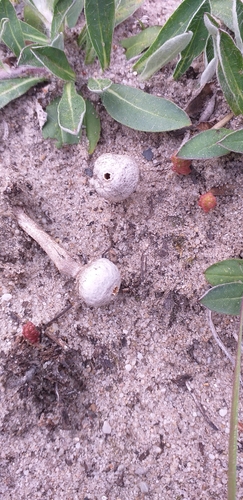
Lepiota subalba
ENEndangered

Lepiota subalba

Local name: Cremeweißer Schirmling

Cremeweißer Schirmling (Lepiota subalba) is a small to medium-sized mushroom characterized by its cream-white cap with delicate scales and slender stem. This saprotrophic fungus plays a crucial ecological role in decomposing organic matter in forest ecosystems, helping to recycle nutrients back into the soil.

Photo: Wikimedia Commons (CC) via https://en.wikipedia.org/wiki/Lepiota_subalba

01Classification

Taxonomy & Classification

Kingdom

Fungi

Phylum

Basidiomycota

Class

Agaricomycetes

Order

Agaricales

Family

Agaricaceae

Genus

Lepiota

Lepiota subalba belongs to the family Agaricaceae, order Agaricales, within the Agaricomycetes class.

02Description

Species Profile

Cremeweißer Schirmling (Lepiota subalba) is a small to medium-sized mushroom characterized by its cream-white cap with delicate scales and slender stem. This saprotrophic fungus plays a crucial ecological role in decomposing organic matter in forest ecosystems, helping to recycle nutrients back into the soil.

Cremeweißer Schirmling (Lepiota subalba) faces severe population declines primarily due to habitat loss from agricultural intensification and urban development across its limited European range. The species' specialized ecological requirements and small, fragmented populations make it particularly vulnerable to environmental changes and human disturbance.

Key Facts

IUCN StatusEndangered (EN)
GroupFungi
03Habitat

Habitat & Distribution

Lepiota subalba typically grows in deciduous and mixed woodlands with rich, humus-laden soils, particularly favoring areas with abundant leaf litter under beech and oak trees. The species is often found in forest clearings and woodland edges where dappled sunlight creates optimal moisture conditions.

TERRESTRIALMajor
04Threats

Threats

!

IUCN Red List: Endangered

Cremeweißer Schirmling (Lepiota subalba) faces severe population declines primarily due to habitat loss from agricultural intensification and urban development across its limited European range. The species' specialized ecological requirements and small, fragmented populations make it particularly vulnerable to environmental changes and human disturbance.

Agricultural intensification and conversion of grasslands

HighOngoing

Urban development and habitat fragmentation

HighOngoing

Changes in land management practices

MediumOngoing

Climate change affecting soil conditions

MediumOngoing

Small population size and genetic isolation

MediumOngoing
Community

Community Sightings

Report a sighting

No community sightings yet. Be the first to report!

07Sources

Sources & Attribution

How to Cite

IUCN: IUCN (2025). The IUCN Red List of Threatened Species. Version 2025-1. Available at: https://www.iucnredlist.org. doi:10.2305/IUCN.UK.2025-1.RLTS

GBIF: GBIF.org (2025). GBIF Home Page. Available at: https://www.gbif.org

This page: SpeciesRadar (2025). Lepiota subalba (Lepiota subalba). SpeciesRadar: Intelligence for Earth's Biodiversity. Available at: https://speciesradar.org/species/cremeweier-schirmling

Full citation guide & data usage terms