Pipping Nursery-Frog
Cophixalus hosmeri
Overview
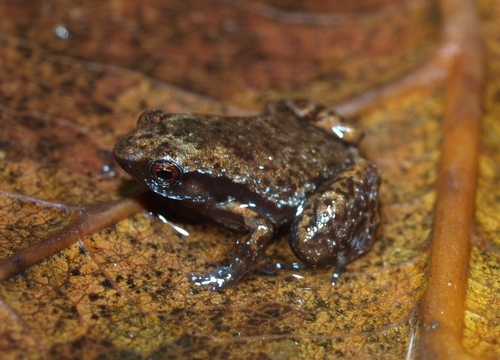
Cophixalus hosmeri is a small terrestrial frog belonging to the family Microhylidae, a group known for direct development in which eggs hatch directly into miniature froglets, bypassing a free-swimming tadpole stage. Like other members of its genus, it likely relies on moist leaf litter and shelters such as logs, rocks, and dense vegetation to avoid desiccation. Its diet presumably consists of small invertebrates found within the leaf litter and forest floor, and it plays a role in local food webs both as a predator of insects and other arthropods and as prey for larger vertebrates.
The species occurs in Australia, restricted to subtropical and tropical moist lowland forest habitats. Its distribution appears limited, consistent with its Endangered classification, and it depends on continuous, undisturbed forest cover with stable humidity and temperature conditions typical of intact rainforest understorey.
Threats to this frog include the ongoing spread of invasive species and disease, which can introduce novel pathogens or competitors into its habitat, alongside pressure from problematic native species interactions. Habitat shifting and alteration, driven by changing environmental conditions, further degrade the microhabitats it requires. Logging and wood harvesting remove forest structure and canopy cover essential for maintaining moisture levels, while the accumulation of garbage and solid waste can degrade habitat quality and potentially introduce contaminants or attract predators.
Conservation efforts for microhylid frogs in similar Australian rainforest habitats typically involve forest protection within reserves, monitoring of amphibian disease such as chytrid fungus, and restrictions on logging in sensitive areas. Specific population figures for this species are not well documented.
Despite the range of ongoing threats, the population trend is currently assessed as stable, suggesting that existing habitat protections and environmental conditions are, for now, supporting a consistent population level within its restricted range.
The Pipping Nursery-Frog faces ongoing pressure from invasive species and diseases, along with harm from native animals or illnesses that disrupt its populations. Its forest habitat is also being altered and degraded through logging and tree removal, while litter and waste pollution further damage its living environment. These combined pressures appear to be persistent rather than improving, suggesting the threats are ongoing and stable rather than clearly increasing or decreasing.
Habitat
Conservation measures underway
Other threatened species in MICROHYLIDAE
Threatened in Australia
Frequently asked questions
Why is Pipping Nursery-Frog classified as Endangered?
Where does Pipping Nursery-Frog live?
What are the main threats to Pipping Nursery-Frog?
Get weekly conservation intelligence
One short digest a week of the most striking species and country data we ship, plus breaking conservation news paired with our database where it matters.
Free, no spam. One-click unsubscribe in every email.