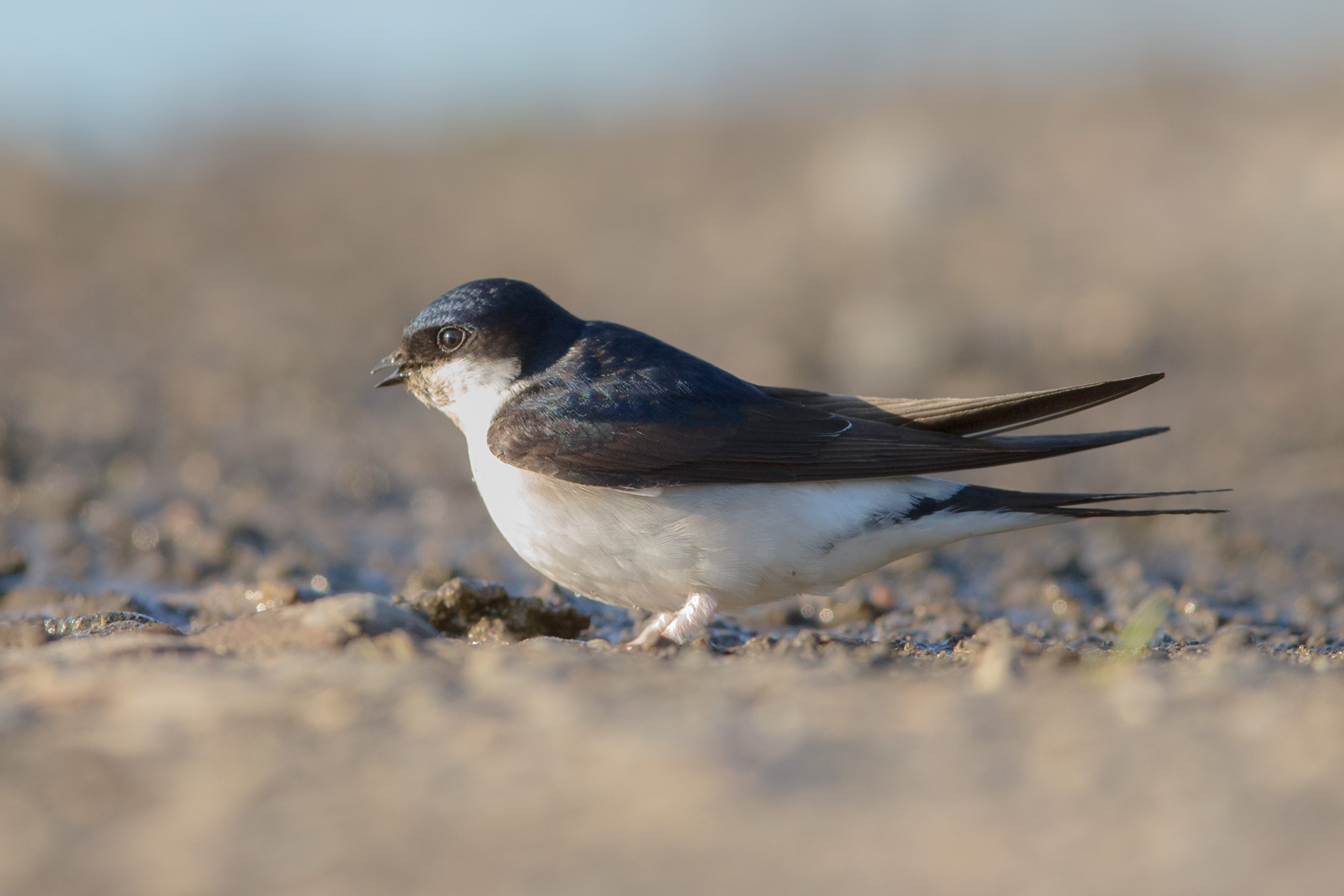
Common House Martin
Delichon urbicum
Photo: Wikimedia Commons (CC) via https://en.wikipedia.org/wiki/Western_house_martin
Overview
The western house martin, sometimes called the common house martin, northern house martin or, particularly in Europe, just house martin, is a migratory passerine bird of the swallow family which breeds in Europe, north Africa and west-central Asia; and winters in sub-Saharan Africa and southwestern Asia. It feeds on insects which are caught in flight, and it migrates to climates where flying insects are plentiful. It has a blue head and upperparts, white rump and pure white underparts, and is found in both open country and near human habitation.
It is similar in appearance to the two other martin species of the genus Delichon, which are both endemic to eastern and southern Asia. It has two accepted subspecies.
The Common House-Martin faces significant population declines across much of its range due to habitat loss, climate change impacts on insect prey availability, and reduced nesting opportunities. Agricultural intensification and urbanization have eliminated traditional mud sources and suitable nesting sites, while pesticide use has dramatically reduced aerial insect populations that form the species' primary food source.
Habitat
Breeds in open countryside, farmland, and urban areas where it constructs mud nests under eaves of buildings, bridges, and cliff overhangs. Requires access to open water or wet mud for nest building materials and aerial foraging areas with abundant flying insects.
Other threatened species in Hirundinidae
Frequently asked questions
Why is Common House Martin classified as Vulnerable?
Where does Common House Martin live?
What are the main threats to Common House Martin?
Get weekly conservation intelligence
One short digest a week of the most striking species and country data we ship, plus breaking conservation news paired with our database where it matters.
Free, no spam. One-click unsubscribe in every email.