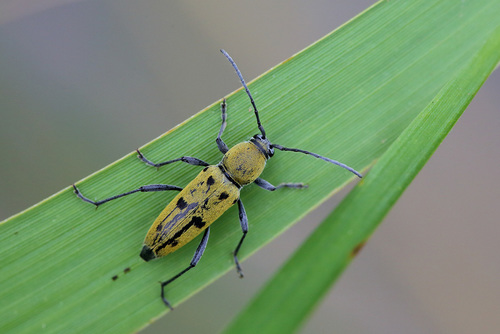
Clyte poilu
Chlorophorus glabromaculatus
Clyte poilu (Chlorophorus glabromaculatus) is a longhorn beetle species characterized by its distinctive smooth, spotted elytra and moderately hairy body segments. This cerambycid beetle plays an important ecological role as a wood-boring insect, with larvae developing in dead or dying hardwood trees, contributing to forest decomposition processes.
14
Countries
Photo: iNaturalist: (c) Erland Refling Nielsen, some rights reserved (CC BY-NC)
Taxonomy & Classification
Kingdom
Animalia
Phylum
Arthropoda
Class
Insecta
Order
Coleoptera
Family
Cerambycidae
Genus
Chlorophorus
Clyte poilu belongs to the family Cerambycidae, order Coleoptera, within the Insecta class.
Species Profile
Clyte poilu (Chlorophorus glabromaculatus) is a longhorn beetle species characterized by its distinctive smooth, spotted elytra and moderately hairy body segments. This cerambycid beetle plays an important ecological role as a wood-boring insect, with larvae developing in dead or dying hardwood trees, contributing to forest decomposition processes.
Chlorophorus glabromaculatus faces severe population declines primarily due to habitat destruction from deforestation and agricultural expansion in its limited range. The species' specialized habitat requirements and small population size make it particularly vulnerable to environmental changes and human disturbance.
Key Facts
Habitat & Distribution
This beetle inhabits mature deciduous and mixed forests where it depends on standing dead trees and fallen logs of various hardwood species for larval development. Adults are typically found on flowering plants in forest clearings and edges where they feed on pollen and nectar.
Threats
IUCN Red List: Endangered
Chlorophorus glabromaculatus faces severe population declines primarily due to habitat destruction from deforestation and agricultural expansion in its limited range. The species' specialized habitat requirements and small population size make it particularly vulnerable to environmental changes and human disturbance.
Agricultural expansion
Deforestation and habitat loss
Small population size and limited range
Host plant degradation
Found in 14 Countries
National vs Global Threat Status
How this species is assessed at the national level compared to its IUCN global status (EN).
| Country | National Status | Global Status | Comparison |
|---|---|---|---|
| EU | LCLeast Concern | ENEndangered | Lower local risk |
| EU | LCLeast Concern | ENEndangered | Lower local risk |
National Red List data sourced from the National Red List Project (nationalredlist.org, ZSL) and country-specific Red List authorities.
Community Sightings
Report a sightingNo community sightings yet. Be the first to report!
Sources & Attribution
How to Cite
IUCN: IUCN (2025). The IUCN Red List of Threatened Species. Version 2025-1. Available at: https://www.iucnredlist.org. doi:10.2305/IUCN.UK.2025-1.RLTS
GBIF: GBIF.org (2025). GBIF Home Page. Available at: https://www.gbif.org
National Red Lists: ZSL (2025). National Red List. Zoological Society of London. Available at: https://www.nationalredlist.org
This page: SpeciesRadar (2025). Clyte poilu (Chlorophorus glabromaculatus). SpeciesRadar: Intelligence for Earth's Biodiversity. Available at: https://speciesradar.org/species/clyte-poilu