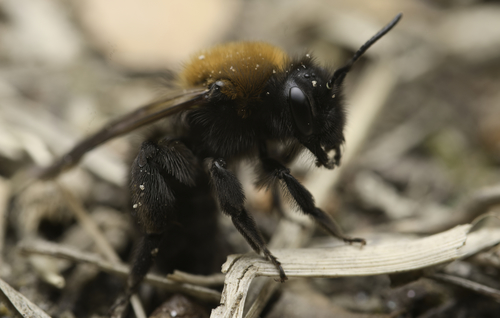
Cliff Mining Bee
Andrena thoracica
The Cliff Mining Bee (Andrena thoracica) is a solitary ground-nesting bee species characterized by its robust build and distinctive thoracic coloration. Females excavate individual burrows in suitable substrate to provision with pollen and nectar for their developing larvae.
46
Countries
Photo: iNaturalist: (c) Panagiotis Dalagiorgos, all rights reserved, uploaded by Panagiotis Dalagiorgos
Taxonomy & Classification
Kingdom
Animalia
Phylum
Arthropoda
Class
Insecta
Order
Hymenoptera
Family
Andrenidae
Genus
Andrena
Cliff Mining Bee belongs to the family Andrenidae, order Hymenoptera, within the Insecta class.
Species Profile
The Cliff Mining Bee (Andrena thoracica) is a solitary ground-nesting bee species characterized by its robust build and distinctive thoracic coloration. Females excavate individual burrows in suitable substrate to provision with pollen and nectar for their developing larvae. As a specialized pollinator, this species plays a crucial role in maintaining plant diversity within its ecosystem.
The Cliff Mining Bee faces severe population declines primarily due to habitat loss from coastal development and quarrying activities that destroy its specialized cliff-face nesting sites. Climate change and sea-level rise pose additional threats to its limited coastal habitat, while agricultural intensification reduces available foraging resources in surrounding areas.
Key Facts
Habitat & Distribution
This species inhabits exposed cliff faces, coastal bluffs, and steep earthen banks where females can excavate nesting burrows in compacted soil or soft rock substrates. They show preference for south-facing slopes with sparse vegetation that provide optimal sun exposure and drainage conditions.
Threats
IUCN Red List: Endangered
The Cliff Mining Bee faces severe population declines primarily due to habitat loss from coastal development and quarrying activities that destroy its specialized cliff-face nesting sites. Climate change and sea-level rise pose additional threats to its limited coastal habitat, while agricultural intensification reduces available foraging resources in surrounding areas.
Coastal development and urbanization
Quarrying and cliff-face destruction
Agricultural intensification reducing floral resources
Climate change and sea-level rise
Habitat fragmentation
Found in 46 Countries
National vs Global Threat Status
How this species is assessed at the national level compared to its IUCN global status (EN).
| Country | National Status | Global Status | Comparison |
|---|---|---|---|
| EU | DDData Deficient | ENEndangered | Lower local risk |
National Red List data sourced from the National Red List Project (nationalredlist.org, ZSL) and country-specific Red List authorities.
Community Sightings
Report a sightingNo community sightings yet. Be the first to report!
Sources & Attribution
How to Cite
IUCN: IUCN (2025). The IUCN Red List of Threatened Species. Version 2025-1. Available at: https://www.iucnredlist.org. doi:10.2305/IUCN.UK.2025-1.RLTS
GBIF: GBIF.org (2025). GBIF Home Page. Available at: https://www.gbif.org
National Red Lists: ZSL (2025). National Red List. Zoological Society of London. Available at: https://www.nationalredlist.org
This page: SpeciesRadar (2025). Cliff Mining Bee (Andrena thoracica). SpeciesRadar: Intelligence for Earth's Biodiversity. Available at: https://speciesradar.org/species/cliff-mining-bee