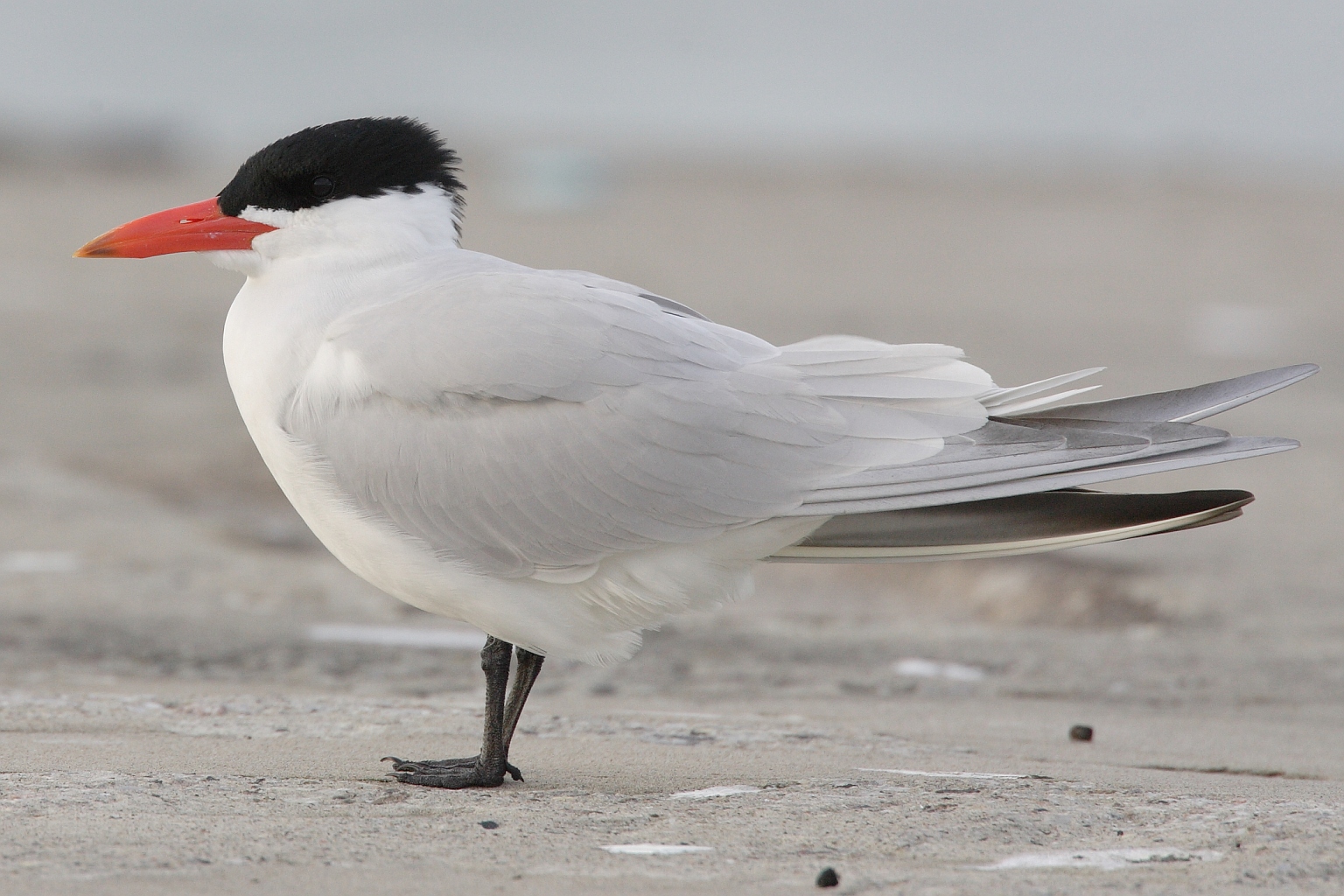
Caspian Tern
CRCritically Endangered

Caspian Tern

Hydroprogne caspia

The Caspian tern is the world's largest species of tern, with a subcosmopolitan but scattered distribution. Despite its extensive range, it is monotypic of its genus, and has no accepted subspecies.

Photo: Wikimedia Commons (CC) via https://en.wikipedia.org/wiki/Caspian_tern

01Classification

Taxonomy & Classification

Kingdom

Animalia

Phylum

Chordata

Class

Aves

Order

Charadriiformes

Family

Laridae

Genus

Hydroprogne

Caspian Tern belongs to the family Laridae, order Charadriiformes, within the Aves class.

02Description

Species Profile

The Caspian tern is the world's largest species of tern, with a subcosmopolitan but scattered distribution. Despite its extensive range, it is monotypic of its genus, and has no accepted subspecies. The genus name is from Ancient Greek hudro-, "water-", and Latin progne, "swallow". The specific caspia is from Latin and, like the English name, refers to the Caspian Sea.

The Caspian Tern faces severe threats from habitat loss due to coastal development, human disturbance at breeding colonies, and climate change impacts on nesting sites. Rising sea levels and increased storm intensity threaten low-lying coastal breeding areas, while pollution and overfishing reduce prey availability in critical feeding waters.

Key Facts

IUCN StatusCritically Endangered (CR)
GroupBirds
03Habitat

Habitat & Distribution

Large inland lakes, coastal lagoons, estuaries, and marine waters, typically nesting on isolated islands, sandy beaches, and artificial structures like dredge spoil islands. Requires open water areas with abundant fish populations for foraging and undisturbed sites with sparse vegetation for colonial nesting.

FRESHWATERMajorMARINEMajorTERRESTRIALMajor
04Threats

Threats

!

IUCN Red List: Critically Endangered

The Caspian Tern faces severe threats from habitat loss due to coastal development, human disturbance at breeding colonies, and climate change impacts on nesting sites. Rising sea levels and increased storm intensity threaten low-lying coastal breeding areas, while pollution and overfishing reduce prey availability in critical feeding waters.

Climate change and sea level rise

HighOngoing

Coastal habitat loss and development

HighOngoing

Human disturbance at breeding colonies

HighOngoing

Pollution and prey depletion

HighOngoing

Invasive species at nesting sites

MediumOngoing
07National Status

National vs Global Threat Status

How this species is assessed at the national level compared to its IUCN global status (CR).

CountryNational StatusGlobal StatusComparison
EULCLeast ConcernCRCritically EndangeredLower local risk

National Red List data sourced from the National Red List Project (nationalredlist.org, ZSL) and country-specific Red List authorities.

Community

Community Sightings

Report a sighting

No community sightings yet. Be the first to report!

07Sources

Sources & Attribution

How to Cite

IUCN: IUCN (2025). The IUCN Red List of Threatened Species. Version 2025-1. Available at: https://www.iucnredlist.org. doi:10.2305/IUCN.UK.2025-1.RLTS

GBIF: GBIF.org (2025). GBIF Home Page. Available at: https://www.gbif.org

National Red Lists: ZSL (2025). National Red List. Zoological Society of London. Available at: https://www.nationalredlist.org

This page: SpeciesRadar (2025). Caspian Tern (Hydroprogne caspia). SpeciesRadar: Intelligence for Earth's Biodiversity. Available at: https://speciesradar.org/species/caspian-tern

Full citation guide & data usage terms