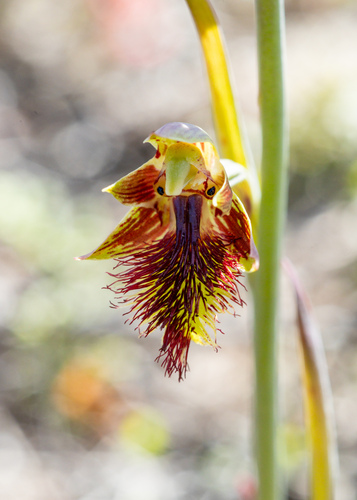
Copper Beard-orchid
Calochilus cupreus
Photo: Photo: (c) Eamonn Culhane, some rights reserved (CC BY), uploaded by Eamonn Culhane
Overview
Calochilus cupreus is a terrestrial orchid characterised by the genus's typical growth form: a single basal leaf, an erect flowering stem, and distinctive fringed, beard-like labellum hairs that mimic female insects to attract pollinating male wasps through pseudocopulation. This pollination strategy makes the species highly dependent on specific insect partners, and like other terrestrial orchids it relies on mycorrhizal fungi in the soil for germination and early growth. As a flowering plant, it contributes to local plant-pollinator networks within its native range.
The species is endemic to Australia, where it occurs in forest and shrubland habitats. Its distribution is naturally restricted and populations are believed to be small and fragmented.
Calochilus cupreus faces a wide array of ongoing pressures. Expansion of housing and urban development, along with livestock grazing and ranching, degrades and fragments remaining habitat. Agricultural and forestry effluents and the spread of annual and perennial non-timber crops further reduce habitat quality.
Altered fire regimes, including both inappropriate burning and fire suppression, disrupt the natural cycles many terrestrial orchids depend on for flowering and regeneration. Logging and wood harvesting remove overstorey structure important to understorey orchid populations, while recreational activities cause trampling and disturbance. Hunting and trapping of terrestrial animals, and harvesting of aquatic resources, may indirectly affect habitat integrity and associated ecological interactions such as pollinator or fungal partner availability.
Conservation attention for this species is limited but consistent with broader efforts to protect Australian terrestrial orchids, including habitat protection within reserves, monitoring of known populations, and research into mycorrhizal associations and pollinator biology to support potential propagation.
Given its Critically Endangered status, decreasing population trend, and the breadth of ongoing threats, the species' outlook remains poor without sustained habitat protection and management intervention.
The Copper Beard-orchid is threatened mainly by land being cleared and developed for housing and towns, as well as ongoing grazing by livestock and farming activities like crop growing that damage its habitat. It also faces pressure from logging, fire and altered fire management, chemical runoff from farms, and disturbance from recreational use, hunting, and harvesting of animals and aquatic resources in its habitat. All of these threats are currently ongoing, suggesting the pressures on this species remain steady rather than easing.
Habitat
Conservation measures underway
Other threatened species in ORCHIDACEAE
Threatened in Australia
Frequently asked questions
Why is Copper Beard-orchid classified as Critically Endangered?
Where does Copper Beard-orchid live?
What are the main threats to Copper Beard-orchid?
Get weekly conservation intelligence
One short digest a week of the most striking species and country data we ship, plus breaking conservation news paired with our database where it matters.
Free, no spam. One-click unsubscribe in every email.