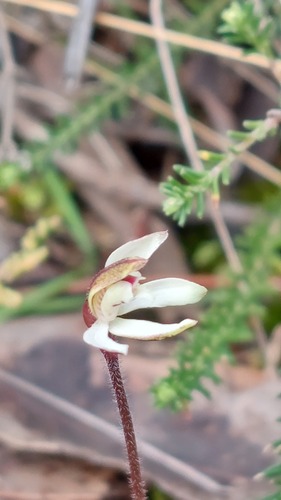
Duramana Fingers
Caladenia attenuata
Photo: Photo: (c) Greg Steenbeeke, some rights reserved (CC BY-NC-SA), uploaded by Greg Steenbeeke
Overview
Caladenia attenuata is a terrestrial orchid belonging to the diverse Caladenia genus, known for its showy, often spider-like flowers borne singly or in small numbers atop slender, hairy stems. Like other members of this genus, it produces a single hairy basal leaf each season and relies on mycorrhizal fungi in the soil for germination and nutrient uptake, an association that makes it highly sensitive to soil disturbance. Its flowers likely depend on specific insect pollinators, a common trait among Caladenia species, though detailed behavioural data for this particular species is limited.
As a perennial geophyte, it dies back to an underground tuber during unfavourable seasons, re-emerging when conditions allow.
The species is endemic to Australia, where it grows in specific regional habitats. It has been associated with caves and subterranean habitat features, suggesting a reliance on particular microclimatic or substrate conditions in these landscapes.
The primary ongoing threat to this orchid is livestock farming and ranching, which degrades habitat through trampling, grazing pressure, and soil compaction, all of which can damage the fragile mycorrhizal relationships and physical structures the species depends on. These pressures have contributed to its Critically Endangered classification and a continuing decreasing population trend.
Specific population figures are not available, but the species' CR status reflects a small, fragmented, and declining population. Conservation responses typically applied to threatened Caladenia species include habitat protection, fencing to exclude livestock, and monitoring of known populations, though details specific to this species are limited. Without effective mitigation of grazing pressure, the species' outlook remains precarious, with continued decline likely absent intervention.
The main ongoing threat to this orchid is livestock farming, where grazing animals can trample plants or damage the soil and vegetation they depend on. This threat is currently stable, as it is described as ongoing rather than increasing or decreasing.
Habitat
Conservation measures underway
Other threatened species in ORCHIDACEAE
Threatened in Australia
Frequently asked questions
Why is Duramana Fingers classified as Critically Endangered?
Where does Duramana Fingers live?
What are the main threats to Duramana Fingers?
Get weekly conservation intelligence
One short digest a week of the most striking species and country data we ship, plus breaking conservation news paired with our database where it matters.
Free, no spam. One-click unsubscribe in every email.