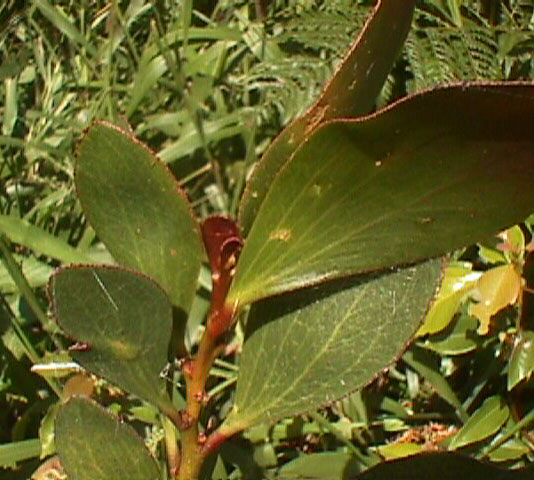
Buffalo Sallow-wattle
Acacia phlebophylla
Photo: Photo: Wikimedia Commons, CC BY-SA
Overview
Acacia phlebophylla is a shrub or small tree in the family Fabaceae, distinguished by its broad, rounded, silvery-grey phyllodes (leaf-like structures) marked with prominent net-like venation, a feature that sets it apart from most other wattles. It produces the typical pale yellow, globular Acacia flower heads, contributing to pollinator activity in its native alpine environment, and its foliage and seed provide food resources for local invertebrates and birds within its restricted habitat.
The species is endemic to a very small area on and around Mount Buffalo in northeastern Victoria, Australia, where it grows on rocky slopes, granite outcrops, and cliff ledges in montane and subalpine terrestrial habitat. Its entire known distribution is confined to this single mountain massif, making it one of the most geographically restricted Acacia species in Australia.
Its extremely limited range makes it acutely vulnerable to disturbance. Altered fire regimes, including both intense bushfires and fire suppression practices that change vegetation structure, threaten to damage populations or degrade the specific rocky microhabitats it depends on. Harvesting and disturbance associated with the collection or use of aquatic resources in nearby catchments also poses a continuing pressure on the surrounding environment.
Given the species' single-location distribution, even localized disturbance events carry disproportionate risk.
Conservation attention has focused on monitoring the existing population within protected areas on Mount Buffalo, where the species' habitat falls under conservation management. Seed banking and ex situ propagation efforts have also been used for other threatened Acacia species and may apply here as a safeguard against catastrophic loss.
Population trends remain unknown due to limited monitoring data. Given its extremely restricted range and ongoing threats, the species' long-term outlook remains precarious, with its classification as Critically Endangered reflecting persistent conservation concern.
Buffalo Sallow-wattle faces ongoing risks from wildfires and from fire management practices, which can damage or destroy the plants and their habitat. It is also affected by ongoing harvesting and fishing activities in its surrounding environment, which may disturb the areas where it grows. Based on the available information, these threats appear to be stable and ongoing rather than clearly worsening or improving.
Habitat
Conservation measures underway
Other threatened species in FABACEAE
Threatened in Australia
Frequently asked questions
Why is Buffalo Sallow-wattle classified as Critically Endangered?
Where does Buffalo Sallow-wattle live?
What are the main threats to Buffalo Sallow-wattle?
Get weekly conservation intelligence
One short digest a week of the most striking species and country data we ship, plus breaking conservation news paired with our database where it matters.
Free, no spam. One-click unsubscribe in every email.