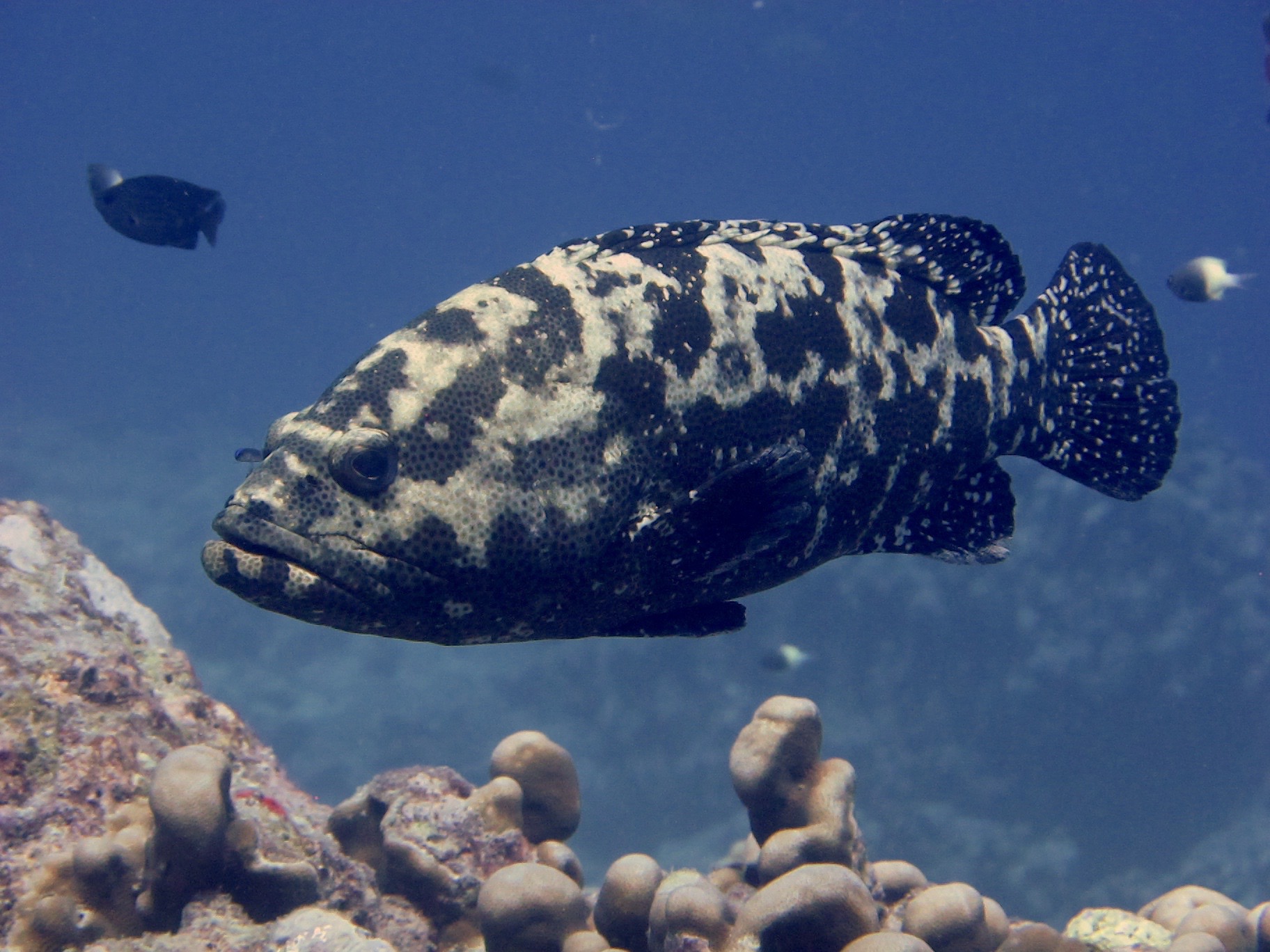
Brown-marbled Grouper
Epinephelus fuscoguttatus
Photo: Wikimedia Commons (CC) via https://en.wikipedia.org/wiki/Brown-marbled_grouper
Overview
The Brown-marbled Grouper is a large reef-associated fish reaching over a meter in length, recognizable by its mottled brown-and-white pattern of blotches and spots covering the body and fins. It is a slow-growing, long-lived predator that feeds on fish, crustaceans, and cephalopods, occupying a top-level position in reef food webs. Like other groupers, it is a protogynous hermaphrodite, changing sex from female to male, and forms predictable spawning aggregations at specific reef sites tied to lunar and seasonal cycles.
The species occurs across the Indo-Pacific, from the Red Sea and East Africa through South and Southeast Asia to Australia, Japan, and numerous Pacific island nations. It inhabits coral reefs, lagoons, and coastal marine waters, typically in shallow to moderate depths, with occasional records in brackish or nearshore wetland-influenced areas.
Its predictable spawning aggregations make it highly vulnerable to targeted fishing, and it is heavily exploited for the live reef fish trade, particularly to supply luxury seafood markets in Asia. Overfishing at aggregation sites has caused localized population collapses. Aquaculture expansion and coastal habitat degradation, including reef damage and altered coastal environments, further reduce available habitat and juvenile recruitment.
Conservation measures include seasonal or permanent closures at known spawning aggregation sites, minimum size limits, and trade monitoring under regional fisheries management frameworks. The species is also included in some marine protected areas across its range, and hatchery-based aquaculture is being developed partly to reduce pressure on wild stocks.
Population trends remain downward across much of its range, driven by continued demand and limited enforcement in many areas. Without stronger, consistently enforced protections at spawning sites, the species is expected to continue declining, warranting its current Vulnerable classification.
The Brown-marbled Grouper faces ongoing pressure from overfishing and harvesting, as it is heavily targeted for the live reef fish trade and food markets. It is also affected by aquaculture activities in coastal waters and by changes to its natural habitat, such as damage to coral reefs where it lives and breeds. These threats are currently ongoing and show no clear sign of easing, suggesting a stable but persistent level of risk to the species.
Habitat
Conservation measures underway
Other threatened species in EPINEPHELIDAE

Threatened in Antarctica



Frequently asked questions
Why is Brown-marbled Grouper classified as Vulnerable?
Where does Brown-marbled Grouper live?
What are the main threats to Brown-marbled Grouper?
Get weekly conservation intelligence
One short digest a week of the most striking species and country data we ship, plus breaking conservation news paired with our database where it matters.
Free, no spam. One-click unsubscribe in every email.