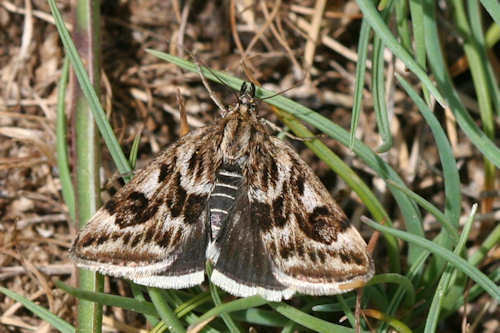
Loxostege manualis
Photo: iNaturalist: (c) Heiner Ziegler, some rights reserved (CC BY-NC), uploaded by Heiner Ziegler
Overview
Loxostege manualis is a species of moth in the family Crambidae. It is found in Sweden, Germany, Austria, Switzerland, France, Spain, Italy, Hungary, Bosnia and Herzegovina, Romania, Bulgaria, the Republic of Macedonia, Albania, Greece and Russia.
Botys des sommets faces significant threats from climate change as warming temperatures force this high-altitude specialist to retreat to increasingly limited mountaintop habitats. Habitat fragmentation and degradation from human activities in alpine regions further restrict available breeding and foraging areas for this vulnerable moth species.
Habitat
This species inhabits high-altitude alpine meadows, grasslands, and rocky slopes typically above 1,500 meters elevation in mountainous regions. It is particularly associated with flower-rich alpine vegetation and subalpine zones where its host plants occur.
Other threatened species in Crambidae


Threatened in Armenia


Frequently asked questions
Why is Loxostege manualis classified as Vulnerable?
Where does Loxostege manualis live?
What are the main threats to Loxostege manualis?
Get weekly conservation intelligence
One short digest a week of the most striking species and country data we ship, plus breaking conservation news paired with our database where it matters.
Free, no spam. One-click unsubscribe in every email.