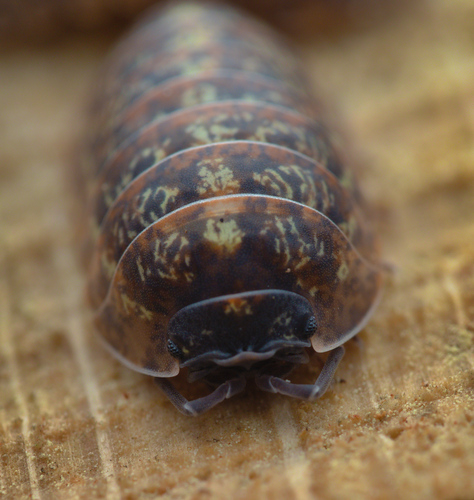
Armadillidium opacum
Photo: iNaturalist: (c) lupalt, some rights reserved (CC BY-NC), uploaded by lupalt
Overview
Armadillidium opacum is a terrestrial isopod belonging to the family Armadillidiidae, the group known as pill bugs or roly-polies for their ability to roll into a tight ball when threatened. Like other members of this family, it possesses a segmented, calcified exoskeleton and respires through modified gill-like structures called pseudotrachea, requiring consistently moist microhabitats to survive. It plays a role as a detritivore, breaking down decaying plant material and contributing to nutrient cycling and soil formation in the leaf litter and upper soil layers it inhabits.
This species has a broad but fragmented distribution across Europe, with records spanning Scandinavia, the Baltic states, Central Europe, France, Italy, and the Balkans, along with isolated populations in Algeria and Australia, the latter likely representing introduced occurrences. It is typically found in terrestrial habitats such as woodland leaf litter, decaying wood, and soil with stable humidity, reflecting its sensitivity to desiccation.
The species faces cumulative pressure from habitat fragmentation and loss driven by urban development and construction, which reduces and isolates suitable moist microhabitats. Agricultural intensification further degrades soil quality and vegetation cover, while changing soil moisture regimes—linked to land-use change and shifting precipitation patterns—directly threaten a species dependent on humid conditions. Pollution and chemical contamination, including agricultural runoff, add further stress to soil ecosystems.
Targeted conservation programs specifically for this isopod are limited, though it benefits indirectly from habitat protection measures within forested and semi-natural areas across its European range. No population figures are currently available, and the trend remains unknown. Given ongoing habitat degradation across much of its range, its conservation trajectory remains uncertain without more focused monitoring and habitat safeguards.
Armadillidium opacum, a small woodlouse species, is primarily threatened by the destruction and breaking-up of its natural habitat as land gets built over for towns, roads, and buildings, as well as farmland being farmed more intensively with heavier machinery and chemical use. Changes in how wet or dry the soil is, along with pollution from chemicals seeping into its environment, also make it harder for this species to survive in the areas it depends on. These threats appear to be ongoing and intensifying as urban and agricultural development continues to expand.
Habitat
Inhabits moist terrestrial environments including deciduous and mixed woodlands, particularly areas with rich leaf litter, rotting logs, and stone crevices that provide stable humidity conditions. The species requires specific microhabitat conditions with adequate moisture retention and organic matter for feeding and shelter.
Threatened in Åland Islands


Frequently asked questions
Why is Armadillidium opacum classified as Vulnerable?
Where does Armadillidium opacum live?
What are the main threats to Armadillidium opacum?
Get weekly conservation intelligence
One short digest a week of the most striking species and country data we ship, plus breaking conservation news paired with our database where it matters.
Free, no spam. One-click unsubscribe in every email.