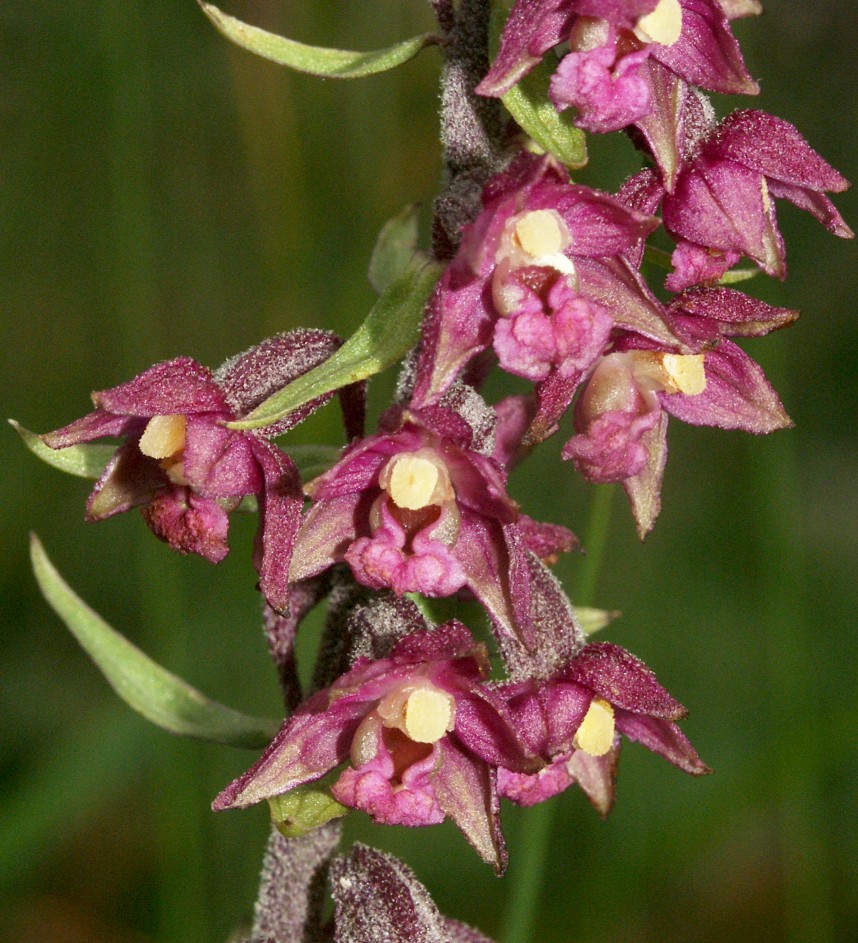
bog orchid
Hammarbya paludosa
Hammarbya paludosa is a small orchid commonly known as bog orchid, bog adder's-mouth or bog adder's-mouth orchid. It grows in bogs in temperate and subarctic regions of the Northern Hemisphere.
Photo: Wikimedia Commons (CC) via https://en.wikipedia.org/wiki/Hammarbya
Taxonomy & Classification
Kingdom
Plantae
Phylum
Tracheophyta
Class
Liliopsida
Order
Asparagales
Family
Orchidaceae
Genus
Hammarbya
bog orchid belongs to the family Orchidaceae, order Asparagales, within the Liliopsida class.
Species Profile
Hammarbya paludosa is a small orchid commonly known as bog orchid, bog adder's-mouth or bog adder's-mouth orchid. It grows in bogs in temperate and subarctic regions of the Northern Hemisphere.
The bog orchid faces severe decline primarily due to habitat destruction and degradation of its specialized wetland environments. Drainage of bogs and fens for agriculture, peat extraction, and urban development has eliminated much of its suitable habitat across its range. Climate change and altered hydrology further threaten the delicate water balance these orchids require.
Key Facts
Habitat & Distribution
Hammarbya paludosa has a wide range around the Northern Hemisphere. In Europe it occurs north to 69° in Scandinavia and south to the Italian Alps, Balkans and Romania. It occurs locally across southern Siberia east to Sakhalin and Japan. In North America, it is found from Alaska east to Ontario and south to Minnesota. (Codes) In the British Isles it is found widely but very locally with the...
Threats
IUCN Red List: Endangered
The bog orchid faces severe decline primarily due to habitat destruction and degradation of its specialized wetland environments. Drainage of bogs and fens for agriculture, peat extraction, and urban development has eliminated much of its suitable habitat across its range. Climate change and altered hydrology further threaten the delicate water balance these orchids require.
Agricultural conversion of wetlands
Habitat loss from bog drainage and peat extraction
Hydrological changes and water table alteration
Climate change affecting bog ecosystems
Urban development and infrastructure
National vs Global Threat Status
How this species is assessed at the national level compared to its IUCN global status (EN).
| Country | National Status | Global Status | Comparison |
|---|---|---|---|
| EU | LCLeast Concern | ENEndangered | Lower local risk |
| EU | LCLeast Concern | ENEndangered | Lower local risk |
National Red List data sourced from the National Red List Project (nationalredlist.org, ZSL) and country-specific Red List authorities.
Community Sightings
Report a sightingNo community sightings yet. Be the first to report!
Sources & Attribution
How to Cite
IUCN: IUCN (2025). The IUCN Red List of Threatened Species. Version 2025-1. Available at: https://www.iucnredlist.org. doi:10.2305/IUCN.UK.2025-1.RLTS
GBIF: GBIF.org (2025). GBIF Home Page. Available at: https://www.gbif.org
National Red Lists: ZSL (2025). National Red List. Zoological Society of London. Available at: https://www.nationalredlist.org
This page: SpeciesRadar (2025). bog orchid (Hammarbya paludosa). SpeciesRadar: Intelligence for Earth's Biodiversity. Available at: https://speciesradar.org/species/bog-orchid