
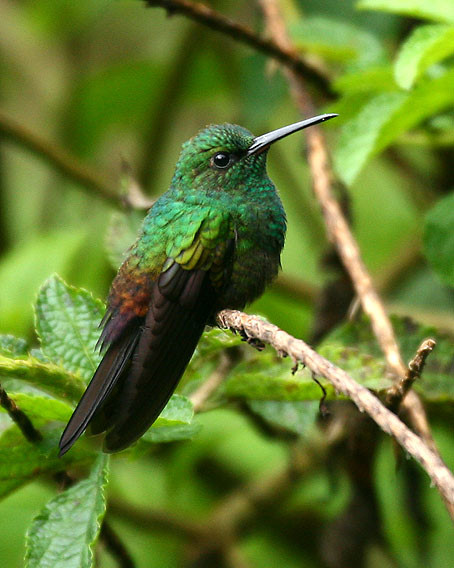
Black-backed Thornbill
Ramphomicron dorsale
Photo: Wikimedia Commons (CC) via https://en.wikipedia.org/wiki/Black-backed_thornbill
Overview
The black-backed thornbill is an Endangered species of hummingbird in the "coquettes", tribe Lesbiini of subfamily Lesbiinae. It is endemic to the Sierra Nevada de Santa Marta of northern Colombia.
The Black-backed Thornbill faces severe population declines primarily due to habitat loss from agricultural expansion, mining activities, and urban development in its restricted Andean range. Climate change poses an additional threat by altering the specific temperature and precipitation conditions required for its high-altitude cloud forest habitat.
Habitat
The black-backed thornbill is restricted to the isolated Sierra Nevada de Santa Marta in far northern Colombia, where it inhabits the edges of humid and elfin forest and also páramo. In elevation it ranges from as high as the snowline at about .
Other threatened species in Trochilidae



Frequently asked questions
Why is Black-backed Thornbill classified as Endangered?
Where does Black-backed Thornbill live?
What are the main threats to Black-backed Thornbill?
Get weekly conservation intelligence
One short digest a week of the most striking species and country data we ship, plus breaking conservation news paired with our database where it matters.
Free, no spam. One-click unsubscribe in every email.