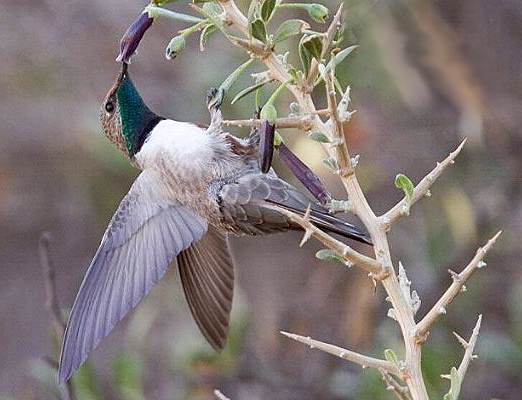
Andean Hillstar
Oreotrochilus estella
Photo: Wikimedia Commons (CC) via https://en.wikipedia.org/wiki/Andean_hillstar
Overview
The Andean Hillstar (Oreotrochilus estella) is a remarkable hummingbird species that has evolved extraordinary adaptations to survive in some of South America's most extreme high-altitude environments. This medium-sized hummingbird measures approximately 12-13 centimeters in length, with males displaying iridescent emerald-green upperparts and a distinctive glittering violet-blue gorget that catches sunlight brilliantly against the stark Andean landscape. Females are more subdued, featuring bronze-green upperparts with whitish underparts marked by green spotting.
The species inhabits the high Andes from Peru through Bolivia to northern Chile and Argentina, typically found at elevations between 3,500 and 5,200 meters above sea level. These hummingbirds demonstrate exceptional physiological adaptations to extreme cold and low oxygen conditions, including specialized hemoglobin that efficiently captures oxygen in thin mountain air and the ability to enter torpor during frigid nights to conserve energy. They feed primarily on nectar from high-altitude flowering plants, particularly Puya species and other alpine flora, supplementing their diet with small insects.
The Andean Hillstar is classified as Critically Endangered by the IUCN, reflecting severe population pressures across its range. Despite these challenges, the species shows remarkable resilience in protected areas, and recent community-based conservation initiatives in Peru and Bolivia have successfully established pollinator gardens that provide crucial feeding stations during harsh weather periods, offering hope for population recovery in key breeding territories.
The Andean Hillstar faces severe threats from mining operations that destroy critical high-altitude habitat, particularly copper and lithium extraction activities that fragment breeding territories and eliminate essential nectar sources. Climate change poses an additional existential threat, as rising temperatures force alpine plant communities upward beyond available habitat, while increasingly unpredictable weather patterns disrupt the precise timing between flowering cycles and breeding seasons that this specialized hummingbird depends upon. Overgrazing by livestock in traditional pastoral areas further degrades the delicate alpine ecosystems, reducing the diversity and abundance of native flowering plants essential for the species' survival.
Habitat
The Andean Hillstar inhabits extreme high-altitude environments including puna grasslands, rocky slopes, and alpine scrublands between 3,500-5,200 meters elevation. These harsh landscapes feature sparse vegetation dominated by cushion plants, alpine grasses, and specialized high-altitude flowering species that bloom during brief growing seasons.
Other threatened species in Trochilidae


Frequently asked questions
Why is Andean Hillstar classified as Critically Endangered?
Where does Andean Hillstar live?
What are the main threats to Andean Hillstar?
Get weekly conservation intelligence
One short digest a week of the most striking species and country data we ship, plus breaking conservation news paired with our database where it matters.
Free, no spam. One-click unsubscribe in every email.