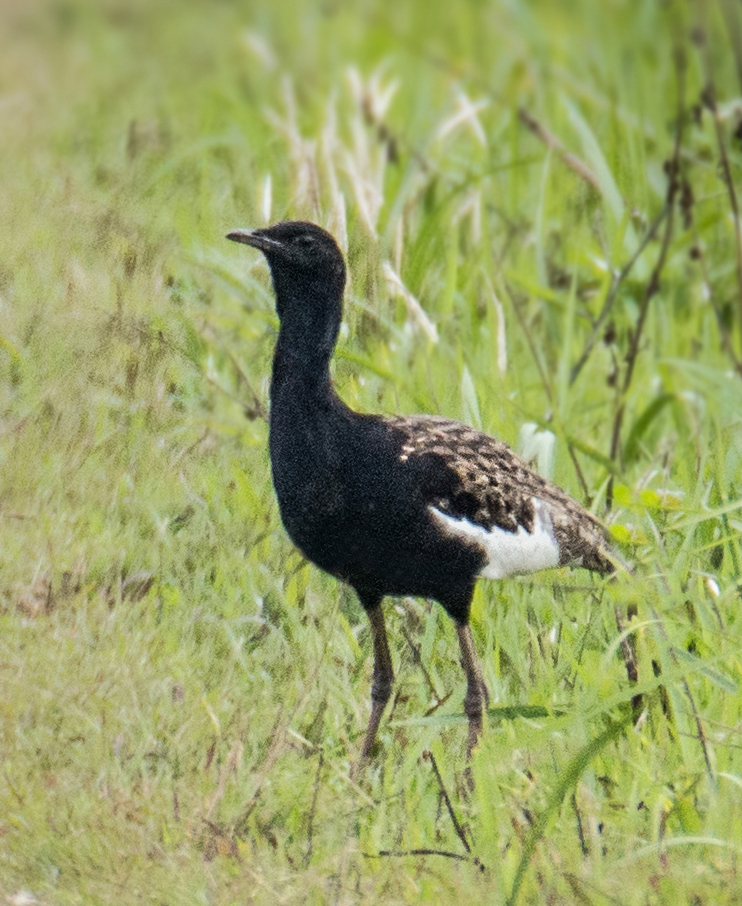
Bengal Florican
Houbaropsis bengalensis
Photo: Wikimedia Commons (CC) via https://en.wikipedia.org/wiki/Bengal_florican
Overview
The Bengal Florican is a large terrestrial bird standing approximately 66-68 cm tall, characterized by its distinctive black and white plumage during breeding season and cryptic brown coloring otherwise. Males perform elaborate aerial courtship displays, leaping into the air with distinctive calls. As a ground-dwelling species, it plays an important role in grassland ecosystems as both predator of insects and small vertebrates, and as prey for larger carnivores.
This species inhabits the Indian subcontinent and Southeast Asia, with populations in India, Nepal, Bangladesh, Cambodia, and Vietnam. It primarily occupies subtropical dry grasslands, particularly the Terai region, along with shrublands, forest edges, and areas near permanent freshwater bodies. The species requires tall grasslands for nesting and open areas for foraging.
The Bengal Florican faces severe pressure from agricultural conversion, particularly rice and sugarcane cultivation by small-holder farmers. Livestock grazing degrades habitat quality, while systematic grass cutting eliminates nesting sites. Infrastructure development including roads and railways fragments remaining habitat. Additional threats include hunting, dam construction affecting water regimes, invasive species, and extreme weather events including storms and flooding.
Conservation efforts focus on habitat protection through community-based management programs and protected area designation. Some regions have implemented grassland restoration projects and sustainable grazing practices. Captive breeding programs operate in select locations.
The species' outlook remains critical. With severely fragmented populations and ongoing habitat loss, the Bengal Florican continues declining across its range. Without immediate, large-scale habitat conservation and threat mitigation, local extinctions are likely to continue.
The Bengal Florican faces its greatest threats from farmers converting grasslands into rice and sugarcane fields, along with cattle grazing that destroys the tall grass habitats these birds need for nesting and feeding. Additional pressures come from people cutting grass for livestock feed, hunting the birds, and the spread of invasive plant species that crowd out native grasses. Most of these threats are ongoing and appear to be stable or intensifying as human populations grow and demand more agricultural land.
Habitat
Conservation measures underway
Other threatened species in OTIDIDAE


Threatened in Bangladesh



Frequently asked questions
Why is Bengal Florican classified as Critically Endangered?
Where does Bengal Florican live?
What are the main threats to Bengal Florican?
Get weekly conservation intelligence
One short digest a week of the most striking species and country data we ship, plus breaking conservation news paired with our database where it matters.
Free, no spam. One-click unsubscribe in every email.