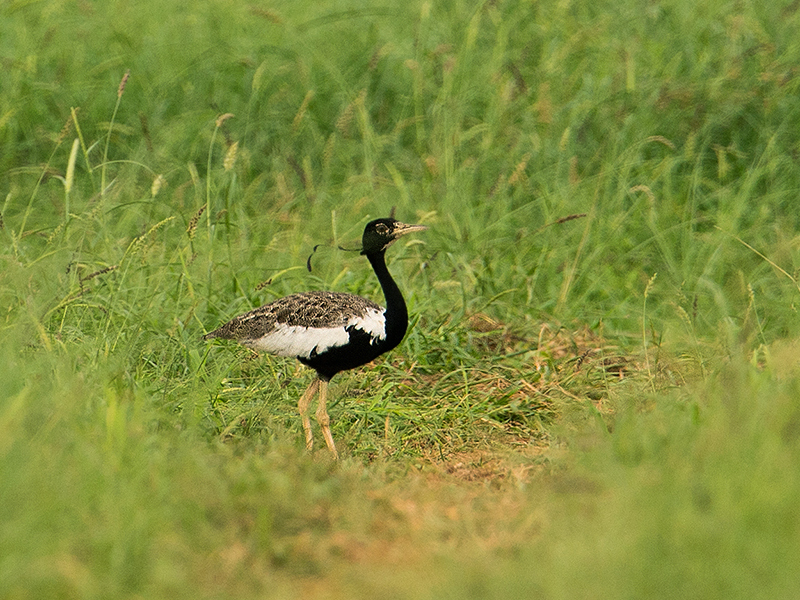
Likh
Sypheotides indicus
Photo: Wikimedia Commons (CC) via https://en.wikipedia.org/wiki/Lesser_florican
Overview
The lesser florican, also known as the likh or kharmore, is the smallest in the bustard family and the only member of the genus Sypheotides. It is endemic to the Indian Subcontinent where it is found in tall grasslands and is best known for the leaping breeding displays made by the males during the monsoon season. The male has a contrasting black and white breeding plumage and distinctive elongated head feathers that extend behind the neck.
These bustards are found mainly in northwestern and central India during the summer but are found more widely distributed across India in winter. The species is highly endangered and has been extirpated in some parts of its range such as Pakistan. It is threatened both by hunting and habitat degradation.
The only similar species is the Bengal florican...
The Lesser Florican (Sypheotides indicus) has experienced severe population declines primarily due to widespread conversion of grassland habitats to agriculture and urban development. Intensive farming practices, pesticide use, and the loss of traditional grazing systems have further degraded remaining suitable habitats, while hunting pressure in some regions continues to impact local populations.
Habitat
The species was formerly more widespread across much of Indian Sub-continent, but not in Sri Lanka. It breeds mainly in the central and western parts of India. Historic records exist from the Makran coast of Balochistan province in Pakistan. The species is said to move in response to rainfall and their presence at locations can be erratic, with sudden large numbers in some seasons. About 500...
Conservation measures underway
Other threatened species in OTIDIDAE


Threatened in India


Frequently asked questions
Why is Likh classified as Critically Endangered?
Where does Likh live?
What are the main threats to Likh?
Get weekly conservation intelligence
One short digest a week of the most striking species and country data we ship, plus breaking conservation news paired with our database where it matters.
Free, no spam. One-click unsubscribe in every email.