
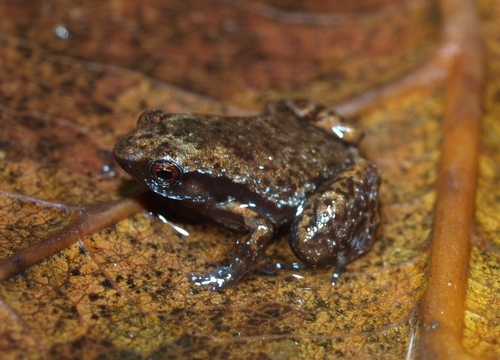
Elegant Frog
Cophixalus concinnus
Photo: Photo: George Chernilevsky via Wikimedia Commons Public domain
Overview
The Elegant Frog is a small terrestrial microhylid frog endemic to Australia. Like other members of the genus *Cophixalus*, it undergoes direct development, meaning eggs laid on damp ground hatch directly into froglets without a free-swimming tadpole stage, bypassing the need for standing water. This life history makes the species highly dependent on consistently moist ground-level microhabitats such as leaf litter, rock crevices, and rotting logs.
As an insectivore, it contributes to invertebrate population regulation within its forest habitat and serves as prey for native predators.
The species is restricted to a very limited range within subtropical and tropical moist lowland forest in Australia, occupying a highly localised distribution that renders it especially vulnerable to habitat-level disturbances.
The Elegant Frog is classified as Critically Endangered, though its population is currently assessed as stable. It faces multiple ongoing pressures, including predation and competition from invasive species, disease, and problematic native species interactions. Habitat shifting and alteration, compounded by logging and wood harvesting, continue to degrade the forest floor conditions the species depends on.
Temperature extremes, likely linked to changing climatic conditions, pose additional risk to a species reliant on stable moisture and thermal microhabitats. Garbage and solid waste accumulation further degrades habitat quality.
Conservation attention for restricted-range Australian frogs typically includes habitat protection within existing reserves, disease and biosecurity monitoring, and ongoing population surveys to detect early signs of decline.
Given its extremely limited range and the continued, unresolved nature of the threats it faces, the species' long-term outlook remains precarious despite the currently stable population trend. Continued monitoring is necessary to detect any shift in this trajectory.
The Elegant Frog faces harm from invasive animals, diseases, and problematic native species that prey on or compete with it, as well as pollution from litter and waste building up in its habitat. Its mountaintop rainforest home is also being altered by shifting environmental conditions, extreme temperature swings, and tree-cutting activities, all of which can dry out or degrade the cool, moist environment this frog depends on. Since all these threats are currently listed as ongoing, the overall pressure on this species appears to be stable to intensifying rather than decreasing.
Habitat
Cophixalus concinnus inhabits the leaf litter and understory of tropical rainforests in northeastern Queensland. The species requires consistently moist microhabitats within dense forest environments for breeding and foraging.
Conservation measures underway
Other threatened species in MICROHYLIDAE
Threatened in Australia
Frequently asked questions
Why is Elegant Frog classified as Critically Endangered?
Where does Elegant Frog live?
What are the main threats to Elegant Frog?
Get weekly conservation intelligence
One short digest a week of the most striking species and country data we ship, plus breaking conservation news paired with our database where it matters.
Free, no spam. One-click unsubscribe in every email.