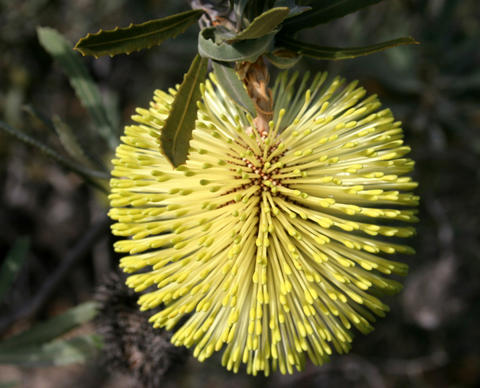
Banksia rosserae
Photo: Wikimedia Commons (CC) via https://en.wikipedia.org/wiki/Banksia_rosserae
Overview
A member of the Proteaceae family, this woody shrub produces the stiff, serrated foliage and distinctive cone-like flower spikes characteristic of the genus Banksia. Its flower heads, composed of densely packed individual florets, produce nectar and pollen that support a range of insects, birds, and small mammals, while its persistent seed follicles provide a slow-release seed bank adapted to periodic disturbance, particularly fire. As part of its ecosystem, it contributes to the structural diversity of the understory and offers a food resource during flowering periods.
Banksia rosserae is restricted to a limited area of Australia, occurring across forest, shrubland, and desert-fringe habitats. Its range is naturally narrow, and known populations are few and geographically confined, a factor that contributes significantly to its critically endangered status.
The species faces multiple compounding pressures. Mining and quarrying activities directly damage or destroy habitat within its restricted range. Changes to natural fire regimes—both increased frequency and altered intensity—disrupt the reproductive cycles many Banksia species depend on for seed release and regeneration.
Competition from invasive plant species reduces access to light, water, and nutrients, while climate change and associated drought stress add physiological strain to an already vulnerable population. Its extremely small population size leaves it highly susceptible to localized disturbances, genetic bottlenecks, and stochastic events.
Conservation attention has focused on habitat protection within its known range, monitoring of existing populations, and management of fire regimes to better align with the species' regeneration needs. Control of invasive competitors is also part of ongoing site management efforts.
The population trend is currently assessed as stable, indicating that immediate decline has been arrested, though the species remains critically endangered due to its small size and the ongoing nature of the threats it faces. Long-term survival depends on sustained habitat protection and threat mitigation.
Banksia rosserae faces pressure from mining and quarrying activity that damages or destroys its habitat, along with changes in how often and how intensely fires occur in the areas where it grows. It also has to compete with invasive plants for space and resources, while hotter and drier conditions linked to climate change add further stress, and its already very small population size makes it especially vulnerable to any of these problems. Overall, these threats appear to be ongoing and stable rather than clearly worsening, though the combination of pressures continues to put the species at risk.
Habitat
Banksia rosserae occurs exclusively in kwongan heath vegetation on deep yellow sand soils in the northern sandplains of Western Australia. This specialized ecosystem is characterized by low, dense shrubland with high plant diversity and is adapted to nutrient-poor soils and Mediterranean climate conditions.
Conservation measures underway
Other threatened species in PROTEACEAE
Threatened in Australia
Frequently asked questions
Why is Banksia rosserae classified as Critically Endangered?
Where does Banksia rosserae live?
What are the main threats to Banksia rosserae?
Get weekly conservation intelligence
One short digest a week of the most striking species and country data we ship, plus breaking conservation news paired with our database where it matters.
Free, no spam. One-click unsubscribe in every email.