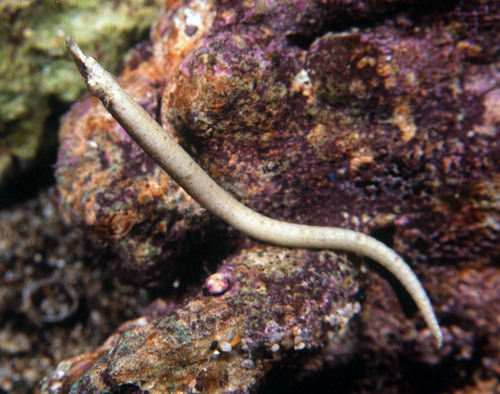
Ball's Pipefish
Cosmocampus balli
Photo: Photo: (c) John Hoover, all rights reserved, uploaded by John Hoover
Overview
Cosmocampus balli is a species of fish of the family Syngnathidae. It is endemic to Hawaii, with observations off Oahu and Kauai. It lives in shallow, protected coral reef or rocky habitats, where it can grow to lengths of 7 centimetres (2.8 in).
Although little is known about its feeding habits, it is expected to consume small crustaceans, similar to other pipefishes. This species is ovoviviparous, with males carrying eggs and giving birth to live young. Males can brood at 4.5 centimetres (1.8 in).
Ball's Pipefish faces significant risk due to its highly restricted coastal distribution, which makes it disproportionately sensitive to localized seagrass and estuarine habitat degradation. Coastal development, water quality decline, and disturbance of shallow nearshore habitats are likely primary pressures given the species' reliance on structured vegetated environments. Because syngnathid reproduction depends on male brood-pouch survival, even modest adult mortality from habitat loss can disproportionately reduce reproductive output and slow population recovery.
Habitat
Ball's Pipefish inhabits shallow coastal and estuarine waters, typically associated with seagrass beds and other structured nearshore vegetation within a narrow geographic range.
Conservation measures underway
Other threatened species in SYNGNATHIDAE
Threatened in United States
Frequently asked questions
Why is Ball's Pipefish classified as Critically Endangered?
Where does Ball's Pipefish live?
What are the main threats to Ball's Pipefish?
Get weekly conservation intelligence
One short digest a week of the most striking species and country data we ship, plus breaking conservation news paired with our database where it matters.
Free, no spam. One-click unsubscribe in every email.