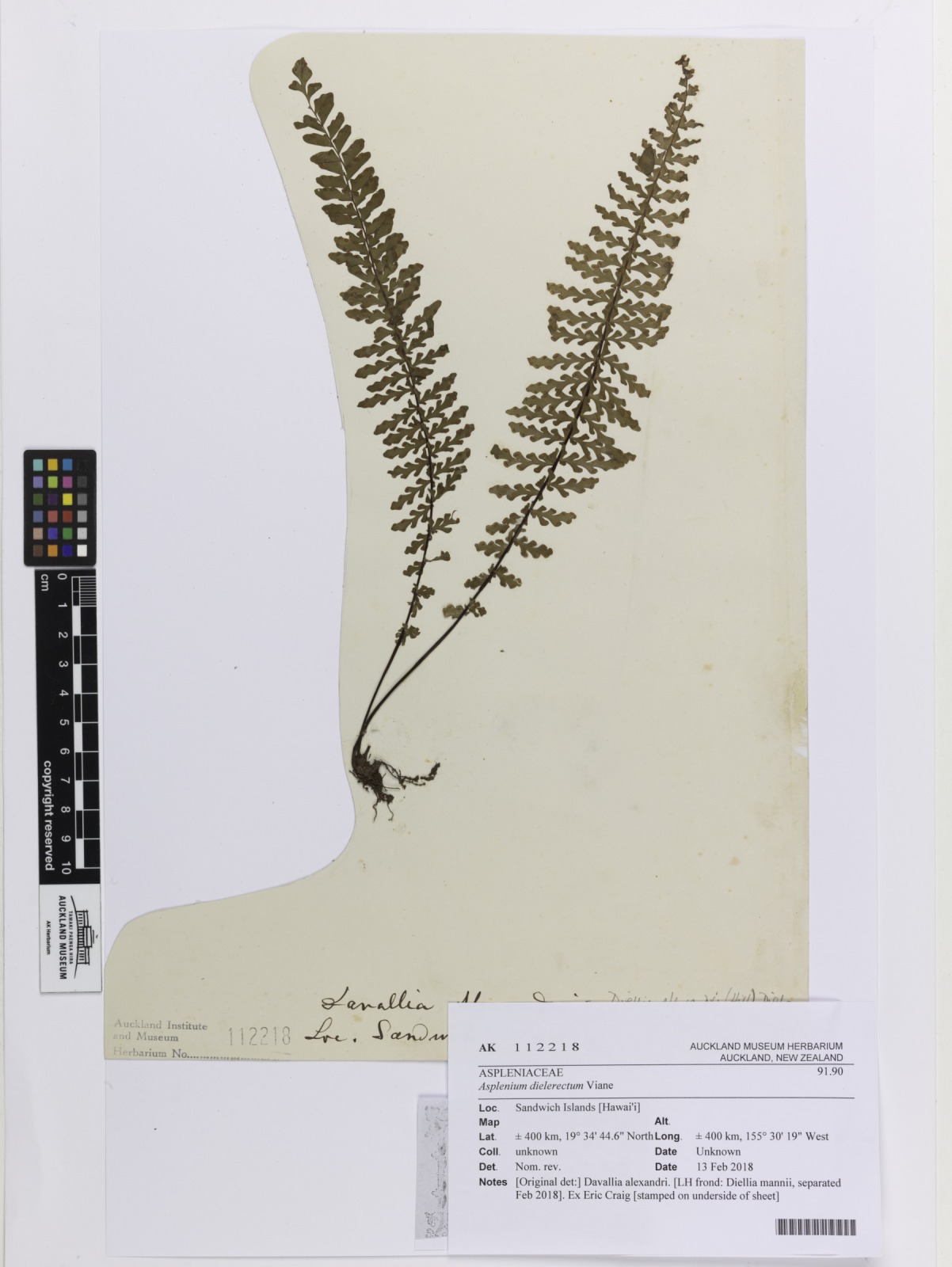
Asplenium-diellia
Asplenium dielerectum
Photo: Photo: Wikimedia Commons, CC BY-SA
Overview
Asplenium dielerectum is a critically endangered fern species belonging to the spleenwort family (Aspleniaceae). This small epiphytic fern is characterized by its distinctive fronds that grow in compact clusters, typically measuring 10-20 centimeters in length. The species exhibits the characteristic linear sori (spore-bearing structures) along the underside of its fronds, arranged parallel to the leaf veins.
As an epiphyte, it plays a role in forest canopy ecosystems by contributing to biodiversity and providing microhabitats for smaller organisms.
The species has an extremely limited geographic distribution, endemic to specific montane forest regions. It inhabits the upper canopy of cloud forests, where it grows on tree branches and trunks in areas with high humidity and consistent moisture levels. These specialized epiphytic communities are found at elevations typically between 1,000-2,000 meters.
The primary threat to A. dielerectum is habitat destruction through deforestation and forest fragmentation. Cloud forests face particular pressure from agricultural expansion, logging, and climate change, which alters the delicate moisture balance these ferns require. The species' restricted range makes it especially vulnerable to localized environmental changes.
Current conservation efforts remain limited due to insufficient research on the species' ecology and distribution. Basic taxonomic and population studies are needed to develop effective protection strategies. The species' critical status reflects both its rarity and the lack of comprehensive threat assessment.
The outlook for A. dielerectum remains uncertain without immediate habitat protection and further scientific investigation to understand its specific requirements and population dynamics.
Based on the available information, the specific threats facing Asplenium dielerectum have not yet been formally assessed or documented by conservation scientists. Without this threat assessment data, it's not possible to identify what particular dangers this fern species may be facing in its natural habitat. The current status of whether threats to this species are increasing, stable, or decreasing cannot be determined without proper scientific evaluation.
Habitat
Conservation measures underway
Other threatened species in ASPLENIACEAE
Threatened in United States
Frequently asked questions
Why is Asplenium-diellia classified as Critically Endangered?
Where does Asplenium-diellia live?
What are the main threats to Asplenium-diellia?
Get weekly conservation intelligence
One short digest a week of the most striking species and country data we ship, plus breaking conservation news paired with our database where it matters.
Free, no spam. One-click unsubscribe in every email.