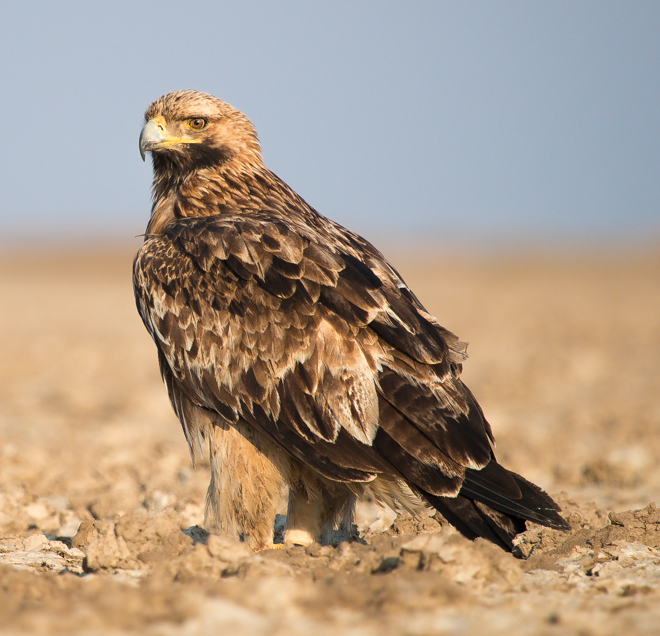
Eastern Imperial Eagle
Aquila heliaca
Photo: Wikimedia Commons (CC) via https://en.wikipedia.org/wiki/Eastern_imperial_eagle
Overview
The Eastern Imperial Eagle is a large raptor with a wingspan reaching 2.2 meters and distinctive golden-buff crown feathers that give adults their characteristic appearance. These powerful predators primarily hunt small mammals, birds, and reptiles across open landscapes, playing a crucial role as apex predators in grassland ecosystems. They are partially migratory, with northern populations traveling significant distances to wintering grounds.
This species inhabits a vast range extending from Eastern Europe through Central Asia to parts of East Africa and the Arabian Peninsula during migration and winter. Eastern Imperial Eagles prefer open grasslands, steppes, and agricultural areas with scattered trees for nesting, typically avoiding dense forests and urban environments.
The species faces mounting pressure from agricultural intensification, particularly the conversion of natural grasslands to intensive crop production, which eliminates both nesting sites and prey habitat. Transportation infrastructure poses significant mortality risks, with birds frequently colliding with power lines and vehicles. Illegal hunting and trapping remain persistent threats throughout much of their range, particularly during migration periods when birds cross international borders.
Conservation efforts include habitat protection programs in key breeding areas, power line modification projects to reduce electrocution risks, and international cooperation agreements under migratory bird treaties. Several countries have established monitoring programs to track population trends and breeding success.
Despite these measures, the Eastern Imperial Eagle continues to experience population decline. The species' dependence on large territories and sensitivity to habitat fragmentation make recovery challenging, requiring sustained international coordination and landscape-scale conservation approaches to reverse current trends.
The Eastern Imperial Eagle faces three main ongoing threats to its survival. Large-scale farming of crops like wheat, corn, and other agricultural plants is reducing the natural grasslands and open areas where these eagles hunt for prey. Additionally, the birds are being killed by collisions with vehicles on roads and trains on railway lines, while some are also being illegally hunted or trapped by people. The current status of these threats appears to be stable and ongoing rather than getting worse or better.
Habitat
Conservation measures underway
Other threatened species in ACCIPITRIDAE


Threatened in Afghanistan

Frequently asked questions
Why is Eastern Imperial Eagle classified as Vulnerable?
Where does Eastern Imperial Eagle live?
What are the main threats to Eastern Imperial Eagle?
Get weekly conservation intelligence
One short digest a week of the most striking species and country data we ship, plus breaking conservation news paired with our database where it matters.
Free, no spam. One-click unsubscribe in every email.