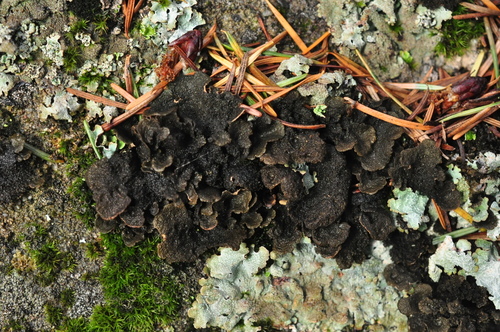
spotted felt lichen
Sticta sylvatica
Photo: iNaturalist: (c) Andrew Simon, some rights reserved (CC BY-NC), uploaded by Andrew Simon
Overview
Ärrlav (Sticta sylvatica)
Ärrlav is a foliose lichen species characterized by its broad, leaf-like thalli that form distinctive lobed structures on tree bark and rock surfaces. This cyanolichen contains cyanobacteria as its primary photosynthetic partner, enabling it to fix atmospheric nitrogen and contribute essential nutrients to forest ecosystems. The species displays a greyish-green coloration when dry, becoming more vibrant when moist.
As an epiphyte, ärrlav plays a crucial role in nutrient cycling and provides microhabitat for various invertebrates.
This lichen occurs in old-growth boreal and temperate forests across northern Scandinavia, with documented populations in Sweden, Norway, and Finland. It requires specific microclimate conditions found in mature forest stands, typically growing on the bark of old deciduous trees, particularly aspen and birch, in areas with high humidity and minimal air pollution.
The species faces severe threats from intensive forestry practices that remove old-growth stands essential for its survival. Clear-cutting eliminates both host trees and the stable microclimate conditions ärrlav requires for reproduction and growth. Air pollution, particularly nitrogen deposition and sulfur compounds, significantly impacts lichen physiology and reduces population viability.
Climate change poses additional pressure through altered precipitation patterns and temperature fluctuations.
Conservation efforts focus on protecting remaining old-growth forest fragments and implementing forestry practices that maintain continuity of suitable habitat. Some Scandinavian countries have established protected areas specifically for lichen conservation, though coverage remains limited.
The current outlook for ärrlav remains precarious, with continued habitat loss outpacing conservation measures. Without expanded protection of old-growth forests, population recovery appears unlikely.
The primary threats to ärrlav (Sticta sylvatica) have not been assessed or documented in available scientific literature. Without a formal threat assessment, it's unclear what specific dangers this species faces or how human activities might be impacting its populations. The status of threats to this species - whether they are increasing, stable, or decreasing - cannot be determined without proper scientific evaluation.
Habitat
Other threatened species in Lobariaceae
Frequently asked questions
Why is spotted felt lichen classified as Critically Endangered?
Where does spotted felt lichen live?
What are the main threats to spotted felt lichen?
Get weekly conservation intelligence
One short digest a week of the most striking species and country data we ship, plus breaking conservation news paired with our database where it matters.
Free, no spam. One-click unsubscribe in every email.