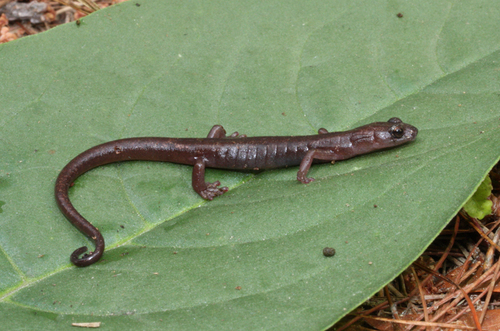
Chiropterotriton arboreus
Photo: (c) 2010 Sean Michael Rovito, some rights reserved (CC BY-NC-SA)
Overview
Chiropterotriton arboreus is a critically endangered salamander endemic to the cloud forests of eastern Mexico, specifically found in the Sierra Madre Oriental mountain range. This small, slender plethodontid salamander exhibits the characteristic features of its genus, with a elongated body, relatively short limbs, and a prehensile tail adapted for arboreal life. Adults typically measure 4-6 centimeters in total length, displaying a dark brown to blackish coloration with subtle lighter markings that provide excellent camouflage against tree bark and moss-covered surfaces.
The species inhabits pristine cloud forest environments at elevations between 1,800-2,400 meters, where it occupies the canopy and understory layers of ancient oak and pine forests. Like other members of the Plethodontidae family, this salamander lacks lungs and breathes entirely through its skin and mouth lining, making it extremely sensitive to environmental changes and air quality. The species is classified as Critically Endangered by the IUCN due to its extremely restricted range and rapidly declining population.
Chiropterotriton arboreus demonstrates remarkable adaptations to its arboreal lifestyle, including specialized toe pads that enable it to navigate vertical surfaces and a fully prehensile tail used for anchoring while foraging. Recent conservation efforts have focused on protecting remaining cloud forest fragments, and several populations persist within protected areas, offering hope for the species' long-term survival if habitat degradation can be halted.
The primary threat to Chiropterotriton arboreus is the rapid destruction and fragmentation of Mexico's cloud forests, which have experienced over 60% habitat loss in recent decades due to agricultural expansion, logging, and human settlement. Climate change poses an additional severe threat, as rising temperatures and altered precipitation patterns are causing cloud forest zones to shift upward in elevation, effectively shrinking the species' available habitat. The salamander's extreme sensitivity to environmental changes, particularly humidity and temperature fluctuations, makes even small-scale habitat disturbances potentially catastrophic for local populations.
Habitat
This species inhabits the canopy and understory layers of pristine cloud forests in Mexico's Sierra Madre Oriental, preferring areas with consistent high humidity, moderate temperatures, and abundant epiphytic vegetation. The salamanders are typically found on moss-covered tree trunks, branches, and rock faces within old-growth forest sections at elevations between 1,800-2,400 meters.


