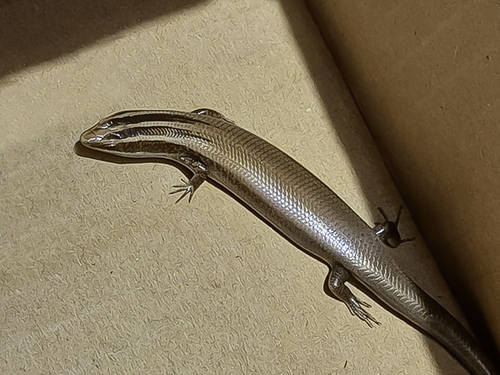
Anegada Skink
Spondylurus anegadae
Photo: Photo: (c) Rondel H. Smith, some rights reserved (CC BY-NC), uploaded by Rondel H. Smith
Overview
The Anegada skink is a medium-sized lizard endemic to Anegada, the northernmost island of the British Virgin Islands. This ground-dwelling reptile typically measures 15-20 centimeters in total length, with a brownish-gray coloration that provides camouflage among rocks and leaf litter. Like other members of the Spondylurus genus, it has smooth, overlapping scales and a cylindrical body adapted for burrowing and moving through dense vegetation.
The species inhabits the dry scrubland and coastal areas of Anegada, foraging for insects, small invertebrates, and plant matter. As both predator and prey, it plays a role in the island's food web, controlling insect populations while serving as food for birds and other predators.
The Anegada skink faces severe threats from habitat destruction due to development and tourism infrastructure. Introduced predators, particularly feral cats and rats, pose significant risks to both adults and eggs. The species' extremely limited range—confined to a single small island—makes it particularly vulnerable to environmental changes and human activities.
Conservation efforts include habitat protection measures and monitoring programs led by local authorities and international conservation organizations. Research initiatives are working to better understand the species' ecology and population status, though current numbers remain unknown.
The outlook for the Anegada skink remains precarious. Its classification as Critically Endangered reflects the urgent need for continued conservation action. The species' survival depends heavily on effective management of introduced predators and protection of remaining suitable habitat on Anegada.
Based on the provided threat data, the specific threats to the Anegada Skink have not been assessed or documented. Without a formal threat assessment, it's not possible to identify what particular dangers this species faces or describe how human activities or environmental changes might be affecting its survival. The status of threats cannot be determined as increasing, stable, or decreasing due to the lack of available threat data.
Habitat
Conservation measures underway
Other threatened species in SCINCIDAE

Threatened in British Virgin Islands


Frequently asked questions
Why is Anegada Skink classified as Critically Endangered?
Where does Anegada Skink live?
What are the main threats to Anegada Skink?
Get weekly conservation intelligence
One short digest a week of the most striking species and country data we ship, plus breaking conservation news paired with our database where it matters.
Free, no spam. One-click unsubscribe in every email.