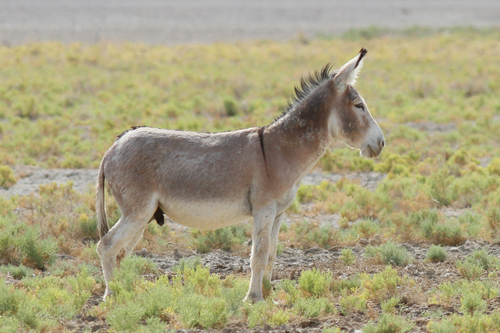
African Wild Ass
Equus asinus
Photo: iNaturalist: (c) Justyn Stahl, some rights reserved (CC BY-NC), uploaded by Justyn Stahl
Overview
The African wild ass is a slender, long-legged equid distinguished by large ears, a short erect mane, and pale grey to fawn coats marked with horizontal dark stripes on the lower legs, a trait shared with its close relatives among the wild asses. It is adapted to arid environments, capable of surviving on sparse, low-quality forage and traveling long distances between scattered water sources. Socially, it forms loose, fluid groups, with adult males typically defending territories near water or resources that attract females.
As a herbivore, it plays a role in shaping vegetation dynamics and seed dispersal across the arid landscapes it inhabits.
Historically ranging across North Africa and the Horn of Africa, the species is now restricted to small, fragmented populations in the deserts and semi-arid grasslands of Eritrea and Ethiopia, with a few isolated remnants elsewhere in its historic range. It occupies rocky hills, plains, and desert terrain, generally avoiding areas with dense human or livestock activity.
Its decline stems from habitat loss and degradation, hunting for meat and use in traditional medicine, and competition with domestic livestock for grazing land and water. Hybridization with domestic donkeys threatens the genetic integrity of remaining wild populations, while ongoing political instability and armed conflict in parts of its range hinder both survival and monitoring efforts.
Conservation actions include legal protections in range states, some habitat monitoring, and captive breeding programs in zoos that maintain genetic reserves as a safeguard. Enforcement and habitat protection remain difficult given regional insecurity. The species remains classified as Endangered, with population trends currently unknown due to limited access and monitoring capacity in its remaining range, leaving its long-term trajectory uncertain.
African Wild Asses are being hunted for their meat and for use in traditional medicine, while also losing access to food and water as livestock herds move into and compete for the same arid grazing lands. Their habitats are shrinking and becoming degraded, and breeding with domestic donkeys is diluting the genetic distinctiveness of wild populations. On top of this, ongoing conflict and political instability in the regions where they live make it hard to protect them or monitor their numbers. These combined pressures appear to be intensifying rather than easing.
Habitat
Other threatened species in Equidae
Threatened in Afghanistan

Frequently asked questions
Why is African Wild Ass classified as Endangered?
Where does African Wild Ass live?
What are the main threats to African Wild Ass?
Get weekly conservation intelligence
One short digest a week of the most striking species and country data we ship, plus breaking conservation news paired with our database where it matters.
Free, no spam. One-click unsubscribe in every email.