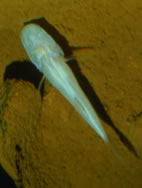
Speoplatyrhinus poulsoni
Photo: Wikimedia Commons (CC) via https://en.wikipedia.org/wiki/Alabama_cavefish
Overview
The Alabama cavefish is a critically endangered species of amblyopsid cavefish found only in underground pools in Key Cave, located in northwestern Alabama, United States in the Key Cave National Wildlife Refuge. It was discovered underneath a colony of gray bats in 1967 by researchers Robert A. Kuehne and John E. Cooper and scientifically described in 1974.
Because Speoplatyrhinus poulsoni is confined to a single cave system, it is exceptionally vulnerable to groundwater pollution from surrounding agricultural and residential land use. Its survival is tightly linked to the health of Key Cave's resident gray bat colony, whose guano forms the base of the cave's sparse food web, so any decline in bat numbers threatens the fish's nutrient supply. Sedimentation and changes in water flow from land development further degrade the specialized pool habitats the species requires.
Habitat
Speoplatyrhinus poulsoni inhabits the flooded passages and pools of Key Cave, a limestone cave system in Lauderdale County, Alabama. The species requires stable groundwater conditions with consistent temperature, dissolved oxygen levels, and minimal chemical fluctuations typical of pristine karst aquifer environments.
Threatened in United States
Frequently asked questions
Why is Speoplatyrhinus poulsoni classified as Critically Endangered?
Where does Speoplatyrhinus poulsoni live?
What are the main threats to Speoplatyrhinus poulsoni?
Get weekly conservation intelligence
One short digest a week of the most striking species and country data we ship, plus breaking conservation news paired with our database where it matters.
Free, no spam. One-click unsubscribe in every email.