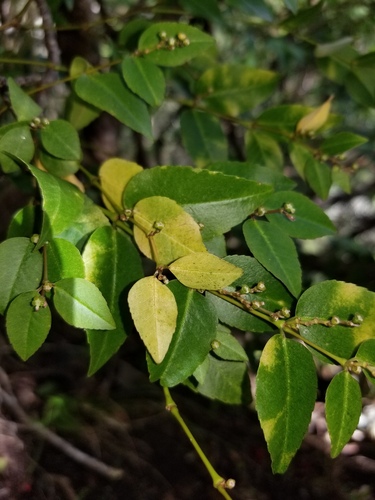
Euphorbia arnottiana
Overview
Euphorbia arnottiana stands as one of India's most critically endangered succulent plants, classified as Critically Endangered (CR) by the IUCN. This distinctive euphorbia exhibits the characteristic thick, fleshy stems and reduced leaves typical of desert-adapted species, with a compact, shrubby growth form that rarely exceeds one meter in height. The plant produces small, inconspicuous cyathia (specialized flower structures) surrounded by yellowish bracts during its flowering period.
Endemic to the arid regions of peninsular India, particularly in Tamil Nadu and Karnataka, this species has adapted to survive in extremely harsh conditions with minimal rainfall and intense solar radiation. Euphorbia arnottiana inhabits rocky outcrops, scrubland, and degraded agricultural margins where few other plants can establish. The species demonstrates remarkable drought tolerance through its succulent stems that store water and waxy cuticles that minimize moisture loss.
Its natural range has contracted dramatically due to habitat conversion for agriculture, urban development, and quarrying activities that destroy the rocky substrates essential for its survival. Mining operations pose a particularly severe threat, as they completely eliminate the specialized microhabitats where remaining populations persist. The species faces additional pressure from collection for traditional medicinal uses and ornamental trade.
Population estimates suggest fewer than 250 mature individuals remain across all known locations, with most subpopulations containing fewer than 50 plants. Encouragingly, recent botanical surveys have rediscovered the species in several locations previously thought to be extirpated, and ex-situ conservation efforts at Indian botanical gardens have successfully propagated the species, offering hope for future reintroduction programs.
Euphorbia arnottiana faces imminent extinction primarily due to quarrying and mining activities that destroy its rocky habitat, with over 60% of historical sites now converted to stone extraction operations. Agricultural expansion into marginal lands has eliminated additional populations, while collection pressure for traditional medicine and succulent trade continues to reduce remaining wild specimens. Climate change intensifies these pressures by altering precipitation patterns in already water-stressed environments where the species barely survives.
Habitat
This species inhabits rocky outcrops, granite inselbergs, and scrubland areas in the semi-arid regions of peninsular India, typically growing in shallow soils between rock crevices at elevations below 500 meters. The specialized habitat requires excellent drainage and exposure to full sunlight, conditions found primarily on weathered granite formations and lateritic plateaus.

