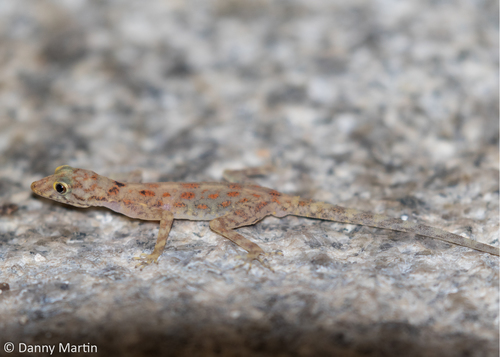
Cnemaspis adii
Local name: Adi’s Day Gecko
Photo: Photo: (c) Danny Martin, some rights reserved (CC BY-NC-ND), uploaded by Danny Martin
Overview
Cnemaspis adii is a critically endangered gecko species endemic to the Western Ghats of India, representing one of the most threatened reptiles in this biodiversity hotspot. This small, nocturnal gecko displays the characteristic features of its genus, with a flattened body, large eyes adapted for night vision, and specialized toe pads that enable it to navigate vertical rock surfaces with remarkable agility. The species exhibits cryptic coloration with intricate patterns of browns and grays that provide excellent camouflage against granite outcrops and weathered rock faces.
Cnemaspis adii inhabits highly specific microhabitats within tropical montane forests, typically found on exposed rock formations and boulder fields at elevations between 800-1200 meters. The species demonstrates strong site fidelity, with individuals often returning to the same crevices and hiding spots during daylight hours. Its diet consists primarily of small arthropods, including ants, termites, and spiders, making it an important component of the forest ecosystem's insectivore guild.
The International Union for Conservation of Nature classifies this species as Critically Endangered due to its extremely restricted range and ongoing habitat degradation. Recent surveys have documented the species from fewer than five locations, all within a severely fragmented landscape. However, encouraging conservation developments include the establishment of new protected areas within its range and increased monitoring efforts by local herpetological societies.
The species' discovery and description have also heightened awareness of gecko diversity in the Western Ghats, leading to enhanced research funding for reptile conservation in the region.
Cnemaspis adii faces severe threats from granite quarrying operations that directly destroy its specialized rock outcrop habitat, with several known populations already eliminated by mining activities. Rapid urbanization and infrastructure development in the Western Ghats have fragmented the remaining suitable habitat into isolated patches, preventing genetic exchange between populations. Climate change poses an additional threat through altered precipitation patterns that affect the moisture-dependent microhabitats this species requires for survival and reproduction.
Habitat
This species inhabits granite rock outcrops and boulder fields within tropical montane forests of the Western Ghats, typically at elevations between 800-1200 meters. It shows strong preference for areas with deep crevices and overhanging rocks that provide shelter and maintain optimal humidity levels.
Conservation measures underway
Other threatened species in GEKKONIDAE
Threatened in India


Frequently asked questions
Why is Adi’s Day Gecko classified as Critically Endangered?
Where does Adi’s Day Gecko live?
What are the main threats to Adi’s Day Gecko?
Get weekly conservation intelligence
One short digest a week of the most striking species and country data we ship, plus breaking conservation news paired with our database where it matters.
Free, no spam. One-click unsubscribe in every email.