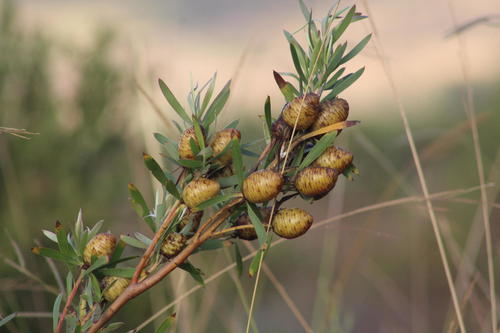
Acacia-leaf Conebush
Leucadendron macowanii
Photo: Photo: (c) Callum Evans, some rights reserved (CC BY-NC), uploaded by Callum Evans
Overview
Leucadendron macowanii is a critically endangered shrub endemic to the Western Cape province of South Africa, representing one of the most threatened members of the diverse Proteaceae family. This distinctive conebush typically grows 1-2 meters tall with narrow, silvery-green leaves and produces small, inconspicuous flowers surrounded by colorful bracts that range from yellow to orange-red during the flowering season from June to August. The species is dioecious, meaning individual plants are either male or female, with male plants producing more vibrant displays while females develop woody cone-like seed heads.
Leucadendron macowanii is restricted to a tiny fragment of fynbos vegetation on sandstone-derived soils in the southwestern Cape, where it occurs at elevations between 200-600 meters. The species' extremely limited distribution encompasses less than 10 square kilometers, making it one of South Africa's most geographically restricted plants. Its natural habitat consists of fire-prone shrublands characterized by nutrient-poor, well-drained acidic soils and a Mediterranean climate with wet winters and dry summers.
The IUCN Red List classifies this species as Critically Endangered due to its severely fragmented population, continuing decline in habitat quality, and extremely small area of occupancy. Current population estimates suggest fewer than 250 mature individuals remain in the wild, distributed across only two or three known locations. Despite its precarious status, recent conservation efforts have shown promise, including successful cultivation at Kirstenbosch National Botanical Garden and ongoing habitat restoration projects that aim to expand suitable growing areas while protecting existing populations from further degradation.
The primary threat to Leucadendron macowanii stems from urban expansion and agricultural conversion within its tiny native range, which has eliminated over 80% of its original habitat. Invasive alien plant species, particularly Australian acacias and pines, aggressively colonize the remaining fynbos fragments and outcompete this slow-growing endemic shrub for resources. Altered fire regimes pose an additional critical threat, as both fire suppression and inappropriate burning intervals disrupt the species' natural regeneration cycle, preventing successful seedling establishment.
Habitat
This species inhabits remnant patches of mountain fynbos on well-drained, acidic sandstone soils in the southwestern Western Cape. The natural vegetation consists of low, sclerophyllous shrublands adapted to periodic fires and characterized by exceptional plant diversity and endemism.
Conservation measures underway
Other threatened species in PROTEACEAE
Threatened in South Africa


Frequently asked questions
Why is Acacia-leaf Conebush classified as Critically Endangered?
Where does Acacia-leaf Conebush live?
What are the main threats to Acacia-leaf Conebush?
Get weekly conservation intelligence
One short digest a week of the most striking species and country data we ship, plus breaking conservation news paired with our database where it matters.
Free, no spam. One-click unsubscribe in every email.