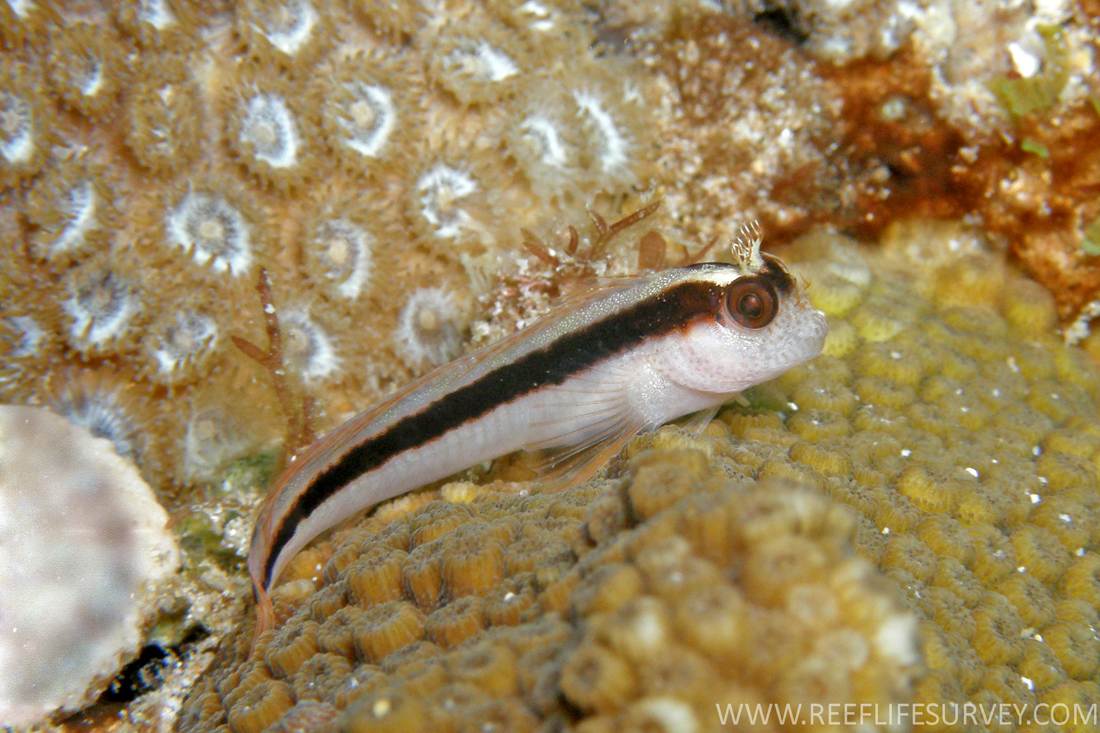
Parablennius serratolineatus
Photo: Wikimedia Commons (CC) via https://en.wikipedia.org/wiki/Parablennius_serratolineatus
Overview
Parablennius serratolineatus is a small, bottom-dwelling fish belonging to the combtooth blenny family, Blenniidae. Like other blennies, it has an elongated, scaleless body, a blunt head, and comb-like teeth adapted for scraping algae and small invertebrates from hard surfaces. Cirri (small fleshy projections) above the eyes are typical of the genus and aid in camouflage among rocky substrates.
Blennies of this type are generally sedentary, territorial, and cryptic, often sheltering in crevices, empty shells, or tide-pool recesses. As grazers and micro-predators, they contribute to controlling algal growth and serve as prey for larger reef and coastal fish, linking primary producers to higher trophic levels in nearshore food webs.
The species occurs in marine rocky habitats, primarily documented around Norfolk Island, an Australian external territory in the South Pacific. Its distribution appears limited to shallow, hard-bottomed coastal zones where rock crevices and tide pools provide shelter and feeding grounds.
The species is currently classified as Vulnerable. Threats include ongoing fishing and harvesting of aquatic resources, which can affect habitat structure and associated prey and competitor species, as well as pollution from garbage and solid waste accumulating in coastal rocky habitats, potentially degrading shelter sites and water quality. Its restricted range increases vulnerability to localized environmental pressures.
Specific targeted conservation programs for this species are not well documented, though its presence within Norfolk Island's marine environments may benefit from broader marine protected area management and waste reduction initiatives applicable to the region's coastal waters.
The population trend is currently reported as stable, suggesting that existing pressures have not yet caused measurable decline. However, its limited geographic range and reliance on undisturbed rocky coastal habitat mean continued monitoring is warranted to ensure this stability persists.
Parablennius serratolineatus faces ongoing pressure from fishing activities that remove fish from its habitat, along with pollution from garbage and solid waste accumulating in its marine environment. These combined threats continue to affect the species without signs of relief. Based on the available information, these threats appear to be stable and ongoing rather than clearly increasing or decreasing.
Habitat
Other threatened species in BLENNIIDAE
Threatened in Australia
Frequently asked questions
Why is Parablennius serratolineatus classified as Vulnerable?
Where does Parablennius serratolineatus live?
What are the main threats to Parablennius serratolineatus?
Get weekly conservation intelligence
One short digest a week of the most striking species and country data we ship, plus breaking conservation news paired with our database where it matters.
Free, no spam. One-click unsubscribe in every email.