Poweshiek Skipperling: 1,300 Released to Wild
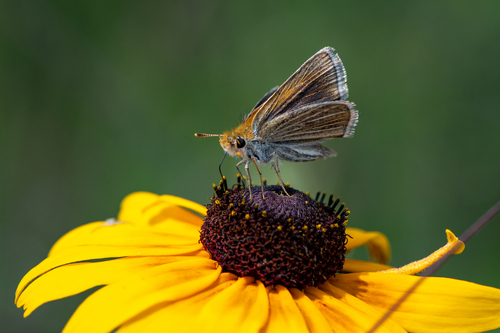
A record release for North America's rarest butterfly
In the restored prairies of the upper Midwest, a tiny orange-brown butterfly is getting a second chance. A captive-rearing partnership between John Ball Zoo and Michigan State University released more than 1,300 Poweshiek skipperlings into the wild in 2025, the largest single-year total since the program began working to pull this species back from near-certain extinction, according to a report from Phys.org.
The Poweshiek skipperling is listed as Critically Endangered by the IUCN Red List, and its population has collapsed so severely over the past two decades that wild sightings have become a rarity even in places it once blanketed by the thousands. A butterfly once common across tallgrass prairie from Iowa to Manitoba now survives in only a handful of fragmented sites, and most of those populations are perilously small. Conservationists involved in the breeding effort say the long-term ambition is nothing less than removing the species from the endangered list altogether — a goal that remains distant but, for the first time in years, feels achievable.

What this means for a vanishing prairie specialist
The Poweshiek skipperling is a small butterfly, with a wingspan of roughly 19 to 25 millimeters, and its fate is tightly bound to the native prairie grasses it depends on for both food and shelter. That specialization is precisely why it has fared so poorly as tallgrass prairie has been plowed under, paved over, or left to grow unchecked without the fires that once swept through and kept the ecosystem healthy. Less than one percent of original tallgrass prairie remains across much of its former range, and the skipperling's limited ability to disperse means it cannot simply relocate when its habitat disappears.
That is where captive rearing comes in. By collecting eggs or larvae from the few remaining wild populations, raising them in controlled conditions where survival rates are far higher than in the wild, and then releasing the resulting adults into restored prairie, researchers are attempting to bypass the bottleneck that has pushed this species to the edge. The scaled-up 2025 release suggests the method is maturing from a small proof-of-concept into something closer to a repeatable, expandable program — a meaningful shift for a species whose total wild numbers have, in recent years, likely been countable in the low thousands or fewer.
Why captive rearing matters here
Captive breeding is not a universal fix for endangered insects, but for a species with such a narrow habitat niche and poor mobility, it offers a way to rebuild numbers faster than nature alone can manage once a population has crashed. Conservationists have paired the rearing effort with active prairie restoration, recognizing that releasing butterflies into degraded land would accomplish little. The strategy depends on three things working in tandem:
- Sourcing genetic material responsibly from the handful of remaining wild colonies without further stressing them
- Rearing larvae and adults in conditions that mimic natural prairie cycles closely enough to prepare them for release
- Restoring and maintaining suitable grassland habitat, including reintroducing controlled burns, so released butterflies have somewhere to actually survive
The wider conservation picture
The Poweshiek skipperling's decline is a case study in how quickly a once-abundant insect can vanish when its habitat is chipped away piece by piece. Historic range included Iowa, Minnesota, Wisconsin, Michigan, North Dakota, South Dakota, and southeastern Manitoba, but the species has already disappeared from large portions of that range entirely. Agricultural conversion remains the dominant driver, but fire suppression has compounded the damage — tallgrass prairie evolved alongside periodic burns that clear woody encroachment and renew the grasses the skipperling relies on. Without fire, prairie remnants slowly become unsuitable even where they survive physically intact.
Climate change adds another layer of uncertainty, altering precipitation patterns and growing seasons in ways that could further stress the narrow ecological window this butterfly occupies. Because Poweshiek skipperlings cannot travel far to find new habitat, every fragmented patch of prairie functions almost like an island — isolated, vulnerable, and difficult to reconnect once a population blinks out.

Outlook: cautious hope on the prairie
No one involved in the recovery effort is describing the skipperling as safe. A single strong release year does not undo decades of habitat loss, and the species remains critically endangered with populations that are still extremely fragile. But the scaling up of captive rearing marks a genuine inflection point. If restored prairie sites can sustain released butterflies through full life cycles and successful reproduction, the program could shift from merely delaying extinction to actually rebuilding a self-sustaining population — the benchmark that would eventually allow a change in its conservation status.
For now, the story is one of incremental progress against a stubborn trend: a butterfly that nearly slipped away is being given, generation by generation, a chance to find its footing again in the grass. Source: original report.
Frequently Asked Questions
What is the Poweshiek skipperling and why is it endangered?
It is a small prairie butterfly native to the upper Midwest and southeastern Canada, classified as Critically Endangered due to extensive tallgrass prairie loss, fire suppression, and its own limited ability to disperse to new habitat.
How many Poweshiek skipperlings were released in 2025?
Conservationists at John Ball Zoo and Michigan State University released more than 1,300 captive-reared individuals into restored prairie habitat, according to Phys.org.
Can captive breeding alone save the species?
Not alone — researchers pair captive rearing with active prairie restoration and fire management, since released butterflies need suitable, well-maintained habitat to survive and reproduce long-term.
Where did the Poweshiek skipperling historically live?
Its range once spanned Iowa, Minnesota, Wisconsin, Michigan, North Dakota, South Dakota, and Manitoba, though it has vanished from much of that territory as prairie has been converted to farmland and development.
Get weekly conservation intelligence
One short digest a week of the most striking species and country data we ship, plus breaking conservation news paired with our database where it matters.
Free, no spam. One-click unsubscribe in every email.