Gilbert's Potoroo: DNA Tools Aid Recovery
A Genetic Lifeline for Australia's Rarest Marsupial
Fewer than 150 Gilbert's potoroos are believed to survive in the wild, making it one of the most imperiled mammals on Earth. According to a report from ScienceDaily, Australian researchers are now turning to advanced environmental DNA analysis to help track and safeguard the species, offering conservationists a faster, less invasive way to monitor a population that has teetered on the edge of extinction for decades.
The technique, often called eDNA, allows scientists to detect a species' presence by sampling soil, water, or scat for trace genetic material rather than relying solely on live trapping or camera surveys. For an animal as elusive and rare as Potorous gilbertii, that distinction matters enormously. Every capture event carries stress and risk for individuals from a population this small, so tools that reduce handling while still yielding reliable data are a welcome addition to the conservation toolkit.
The Gilbert's potoroo is classified as Critically Endangered on the IUCN Red List, the last category before Extinct in the Wild. It is currently restricted to a strikingly small range in southwestern Australia — primarily the Two Peoples Bay Nature Reserve near Albany, along with a handful of translocated populations on predator-free offshore islands and fenced mainland sanctuaries. That narrow footprint makes it one of the most range-restricted mammals on the continent, and it is precisely this concentration in a few vulnerable sites that has conservationists searching for better monitoring methods.
What This Means for the Species
Environmental DNA sampling won't by itself reverse the potoroo's decline, but it changes what's possible in day-to-day conservation management. Rangers and researchers can survey larger areas more frequently, catch early signs of population shifts, and verify whether translocated groups on islands like Bald Island are persisting and expanding — all without the labor-intensive live-trapping programs that have traditionally defined potoroo monitoring.
This matters because the species' entire wild future depends on a mosaic of small, carefully managed populations. Losing track of even one site, or missing an early decline, could mean losing a meaningful fraction of the global population outright. Faster detection means faster intervention — whether that's predator control, habitat protection, or planning for another translocation.
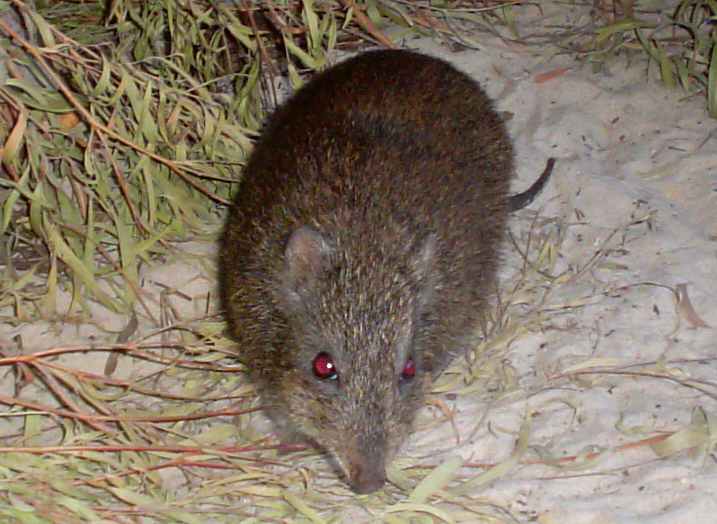
Gilbert's potoroo is a compact, nocturnal marsupial in the potoroid family, related to kangaroos and wallabies but built more like an oversized rat with a kangaroo's gait. It has greyish-brown fur, a pointed snout, and a prehensile tail it uses to carry bedding material back to its nest. Unusually among mammals, it is largely mycophagous — its diet consists heavily of underground fungi, supplemented by roots, seeds, and invertebrates. By digging for fungi and dispersing spores through its droppings, the potoroo performs an outsized ecological role, linking fungal networks with the vegetation that depends on them and helping maintain soil health across its shrubland habitat.
Why the Population Stayed So Small
Gilbert's potoroo was believed extinct for more than a century before a small relict population was rediscovered near Albany in 1994. Since then, conservation efforts have focused on protecting that stronghold and establishing insurance populations elsewhere. But the species remains acutely vulnerable, for several compounding reasons:
- Wildfire risk — a single large bushfire event at Two Peoples Bay could devastate the last significant natural population, as nearly happened during past fire seasons.
- Introduced predators — feral cats and foxes prey on potoroos, especially in unfenced or lightly protected habitat.
- Habitat loss and fragmentation — coastal shrubland has been reduced and broken up, leaving fewer options for range expansion.
- Climate pressures — rising sea levels and shifting rainfall patterns threaten the coastal habitat the species depends on.
- Genetic bottleneck — with so few individuals remaining, inbreeding depression is a growing concern for long-term population resilience.
The Wider Conservation Picture
Gilbert's potoroo's story mirrors a broader pattern among Australia's small mammals, many of which have suffered dramatically since European settlement introduced foxes and cats to a landscape where native species had no evolutionary defenses. Fenced, predator-free sanctuaries and offshore island translocations have become standard tools for species in this position, buying time while researchers and land managers work on longer-term solutions like broad-scale predator control and habitat restoration.
The application of eDNA techniques to Gilbert's potoroo reflects a wider trend in conservation science, where genetic monitoring is increasingly used for cryptic, low-density, or highly sensitive species. Similar approaches have supported recovery tracking for other critically endangered animals worldwide, allowing teams to detect presence, estimate rough abundance, and even assess genetic diversity from minimally invasive samples.
For a species with as fragile a foothold as this one, every incremental improvement in monitoring precision has outsized importance. A population numbering in the low hundreds cannot absorb repeated management missteps, so the margin for error is thin and the value of better data is correspondingly high.
Outlook
Recovery for Gilbert's potoroo will likely continue to depend on a combination of strategies: maintaining and expanding predator-free refuges, protecting remaining shrubland from fire and clearing, managing genetic diversity across dispersed populations, and now, increasingly, using genetic monitoring tools to guide decisions in near real time. There is no quick fix for a species this rare, but the introduction of more sensitive, less disruptive tracking methods gives conservationists a sharper picture of where the animal still persists and where intervention is most urgently needed.
Frequently Asked Questions
How many Gilbert's potoroos are left in the wild?
Fewer than 150 individuals are estimated to survive, spread across a small natural population near Albany and several translocated groups on islands and fenced mainland sites.
What is environmental DNA and why does it help this species?
Environmental DNA, or eDNA, detects genetic traces left in soil, water, or scat, letting researchers confirm a species' presence without trapping or handling individual animals — a major advantage for a population this sensitive to disturbance.
What is the biggest threat to Gilbert's potoroo?
Wildfire poses the most acute risk given the species' concentration in a single small natural stronghold, though predation by feral cats and foxes, habitat fragmentation, and low genetic diversity are all significant ongoing pressures.
Where does Gilbert's potoroo live?
It is found primarily at Two Peoples Bay Nature Reserve near Albany in southwestern Australia, with additional translocated populations on offshore islands and fenced mainland reserves.
Get weekly conservation intelligence
One short digest a week of the most striking species and country data we ship, plus breaking conservation news paired with our database where it matters.
Free, no spam. One-click unsubscribe in every email.