Giant Softshell Turtle: 297 Hatchlings Emerge
A record season on the Mekong
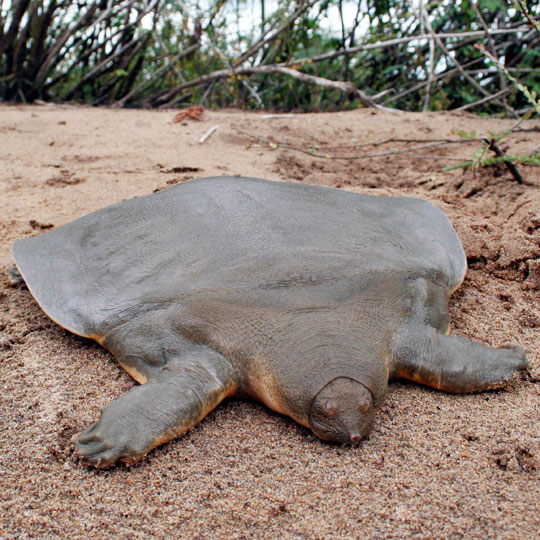
Along a quiet, sandy stretch of the Mekong River in northeastern Cambodia, conservationists have just tallied one of the most encouraging breeding seasons in recent memory for one of the world's largest and least-known freshwater turtles. The Wildlife Conservation Society (WCS) in Cambodia reports that roughly 257 Cantor's giant softshell turtle hatchlings clawed their way out of riverbank nests during the 2026 nesting season, according to Xinhua's report. Combined with hatchlings from earlier monitoring, the season's total climbed to roughly 297 — a striking number for a species many biologists once feared had all but vanished from the wild.
The species, known scientifically as Pelochelys cantorii and listed in our database as the Asian Giant Softshell Turtle, is classified as Critically Endangered on the IUCN Red List. You can explore its full profile on the frog-faced softshell turtle species page, where its conservation status and threat history are tracked alongside hundreds of other imperiled reptiles.

Why this species is so hard to find
Cantor's giant softshell turtle is a master of concealment. Adults can grow to nearly two meters in length yet spend up to 95 percent of their lives buried in river sediment, surfacing only briefly to breathe. That secrecy long made scientists assume the species was rare or absent across much of Southeast Asia — until Cambodian fishers and WCS researchers discovered nesting activity along the Mekong roughly two decades ago. Since then, a community-based nest protection program has become the backbone of the species' recovery in the country, employing local river guardians to locate nests, safeguard eggs from poaching, and monitor hatchling emergence each dry season.
What this means for the species
A single season of 297 hatchlings will not, by itself, rebuild a population that has been hammered for generations. But the milestone signals that the underlying conservation infrastructure — nest patrols, community incentives, and river protection zones — is functioning at a scale sufficient to produce meaningful reproductive output year after year. For a species whose global population size remains poorly quantified, largely because individuals are so difficult to detect and count, consistent hatchling numbers are one of the best available proxies for population trend.
Conservation biologists monitoring the Mekong population note that:
- Nest survival rates have improved substantially since community patrols began, compared with historical baselines when egg collection was nearly universal.
- The Mekong stretch monitored by WCS Cambodia is now considered one of the most important known nesting strongholds for the species anywhere in its range.
- Hatchling counts have shown a generally upward trajectory over recent seasons, though annual totals still fluctuate with river conditions and flooding patterns.
- Local fishing communities that once collected turtle eggs for consumption now receive incentives to report and protect nests instead.

The wider conservation picture
Cantor's giant softshell turtle's troubles are emblematic of what has happened to freshwater megafauna across Asia's great rivers. The species' decline has been driven overwhelmingly by human demand: turtles and their eggs harvested for food and traditional medicine, entire nesting beaches stripped bare before eggs could hatch, and populations extirpated from rivers where they were once common. Layered on top of direct exploitation are the structural pressures reshaping the Mekong itself — dam construction that alters water flow and sediment deposition, sand mining that destroys the very riverbanks turtles need to nest, and agricultural and industrial runoff that degrades water quality in the deep pools the species depends on.
Cambodia's Mekong population is now considered one of the last strongholds for a species that has been declared regionally extinct or functionally absent from large parts of its historical range across South and Southeast Asia, including areas of India, Bangladesh, Myanmar, and Indonesia where it was once documented. That makes every nesting season on this river disproportionately important to the species' global survival prospects.
A model for other river species
WCS Cambodia's approach — pairing scientific monitoring with direct economic incentives for local communities — mirrors strategies used elsewhere for other critically endangered river species, including the Mekong's dwindling giant catfish and various softshell turtle relatives across South Asia. Conservationists increasingly view this community-guardianship model as one of the more replicable tools for protecting freshwater species that are otherwise nearly impossible to police through enforcement alone.
Outlook
None of this guarantees the species' long-term recovery. Softshell turtles mature slowly and reproduce over decades, meaning today's hatchlings won't contribute new eggs to the population for many years. Continued funding, sustained community buy-in, and protection from upstream development pressures — particularly further dam construction — will determine whether this season's hatchling surge becomes a durable trend or a temporary bright spot. Still, for a species so elusive that its very existence in Cambodia went undocumented until relatively recently, 297 hatchlings emerging into the Mekong represents a rare and welcome data point of hope.
Frequently Asked Questions
What is Cantor's giant softshell turtle?
It is a large freshwater turtle species, scientifically named Pelochelys cantorii, that spends most of its life buried in river sediment and is known in our database as the Asian Giant Softshell Turtle.
Why is this species considered Critically Endangered?
Decades of egg collection, hunting for food and traditional medicine, habitat destruction from dam building and sand mining, and river pollution have driven steep population declines across its range.
Where was this hatchling milestone recorded?
Along a monitored stretch of the Mekong River in Cambodia, where the Wildlife Conservation Society runs a community-based nest protection program.
Does 297 hatchlings mean the species is recovering?
It's an encouraging sign that protection efforts are working, but the species reproduces slowly and remains critically endangered, so sustained conservation investment is still essential.
Get weekly conservation intelligence
One short digest a week of the most striking species and country data we ship, plus breaking conservation news paired with our database where it matters.
Free, no spam. One-click unsubscribe in every email.