Asian Giant Softshell Turtle: 297 Hatchlings
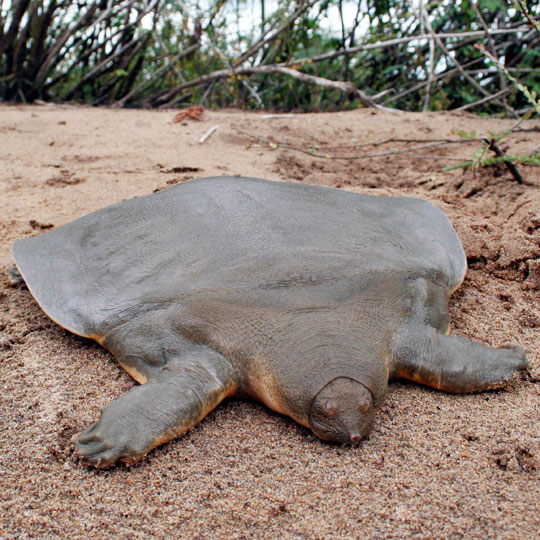
A record season on the Mekong
Along a stretch of the Mekong River in Cambodia, conservationists have logged one of the most encouraging breeding seasons in years for one of the world's most imperiled freshwater reptiles. The Wildlife Conservation Society's Cambodia program reported that roughly 257 Cantor's giant softshell turtle hatchlings emerged from riverbank nests in 2026, contributing to a season total described in Cambodian state media as 297 rare turtle hatchlings, according to Xinhua.
The species at the center of this story is known scientifically as Pelochelys cantorii, and on SpeciesRadar it is catalogued as the Asian Giant Softshell Turtle — a name that reflects both its enormous size and its flattened, frog-like face. The species carries a Critically Endangered listing on the IUCN Red List, the second-highest threat category before extinction in the wild, and its population trend across its range remains poorly documented, a reflection of just how elusive and rare this animal has become in the rivers of Southeast Asia.

What this means for a nearly vanished giant
For a species that can grow a shell exceeding half a meter across and spend most of its life buried motionless in river sediment, breathing through specialized skin membranes rather than surfacing often, even a few hundred hatchlings represents a meaningful data point. Cantor's giant softshell turtle is so cryptic that for long stretches in the twentieth century, biologists assumed some regional populations had already blinked out entirely. Its rediscovery in Cambodian waters in the early 2000s was itself considered a minor sensation among herpetologists, and every subsequent nesting season has been watched closely as an indicator of whether the species can hold its ground.
The 2026 hatchling count builds on years of patient work by conservation teams who patrol riverbanks during nesting season, locate camouflaged nests before poachers or natural predators find them, and in many cases relocate eggs to guarded hatcheries or protect nests in place with cages and round-the-clock monitoring. This kind of hands-on nest protection has become the primary lever available to conservationists, because so many of the turtle's original nesting beaches have already been lost or degraded.
Why numbers like these matter
A single nesting female Cantor's giant softshell turtle can lay dozens of eggs, but survival to hatching, let alone to adulthood, has historically been very low across the species' range. Conservationists tracking the Mekong population have noted that community engagement — paying local residents to report and guard nests rather than harvest them — has been central to turning egg-laying events into actual hatchlings reaching the water.
- Nest protection programs along the Cambodian Mekong have shifted local incentives away from egg collection and toward conservation payments
- Riverbank patrols during the dry-season nesting window help intercept poaching before eggs are removed
- Hatchery-style protection or in-situ nest caging has raised survival rates for eggs that would otherwise be lost to flooding, predation, or theft
- Continued monitoring allows researchers to track whether Cambodia's population, one of the last strongholds for the species, is stabilizing
The wider threat picture
Even with a strong hatchling season, the Asian giant softshell turtle remains under sustained pressure across nearly its entire historical range, which once stretched from India through Southeast Asia to the Philippines. The species has been pushed toward extinction primarily by intensive harvesting for food markets and traditional medicine, a demand that has persisted for decades even as wild populations collapsed. Egg collection and nest destruction have wiped out successful reproduction at many historical breeding beaches, meaning that in much of its former range, the turtle likely no longer reproduces successfully at all without direct human intervention.
Habitat degradation compounds the harvesting pressure. Dam construction along major river systems has altered water flow and sediment patterns that these turtles depend on for both foraging and nesting, while sand mining — often for construction material — physically removes the very riverbanks where females need to dig nests. Agricultural runoff and industrial discharge add a further layer of stress, degrading water quality in the large, slow-moving rivers this species requires to survive. Taken together, these threats explain why the Critically Endangered classification has held for so long, and why isolated good news, like this year's Mekong hatchling count, is treated with cautious optimism rather than celebration of a turnaround.

Looking ahead
Conservation groups working in Cambodia have signaled plans to expand nest monitoring further along the Mekong and its tributaries, betting that sustained community involvement and consistent patrols can gradually rebuild confidence in the population's trajectory. Whether 2026's hatchling numbers mark the beginning of a durable recovery or simply a good year within a long decline will depend on whether these young turtles survive to adulthood — a process that, for a species this large and slow-growing, will take many years to confirm. For now, conservationists are treating the season as proof that dedicated, boots-on-the-riverbank protection can still produce results for one of the planet's most overlooked giant reptiles.
Frequently Asked Questions
What is the Asian giant softshell turtle's IUCN status?
It is listed as Critically Endangered, the most severe category before a species is considered extinct in the wild, reflecting decades of decline from harvesting and habitat loss.
Why did Cambodia see so many hatchlings in 2026?
Conservation teams credit sustained nest protection efforts, including riverbank patrols and community-based monitoring, that shield eggs from poaching and natural threats during the nesting season.
Where does this turtle live?
Historically it ranged across South and Southeast Asia's major river systems, but strongholds are now largely limited to a handful of areas, including parts of the Cambodian Mekong.
Is this hatchling season a sign of full recovery?
Not yet. It's an encouraging signal, but the species still faces harvesting pressure, dam construction, sand mining, and pollution, so long-term survival of these hatchlings to adulthood remains the real test.
Get weekly conservation intelligence
One short digest a week of the most striking species and country data we ship, plus breaking conservation news paired with our database where it matters.
Free, no spam. One-click unsubscribe in every email.