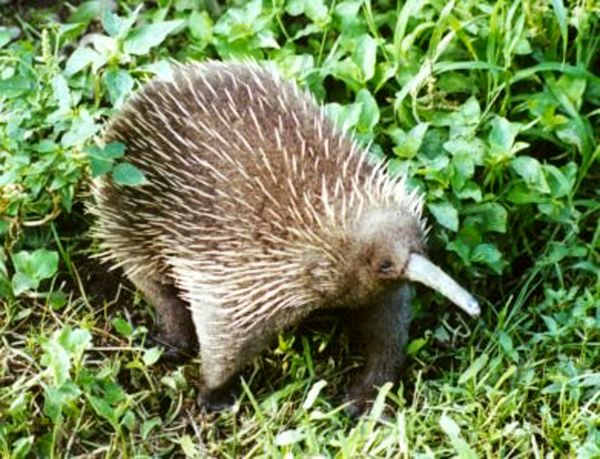
Western Long-beaked Echidna
Zaglossus bruijnii
Overview
This elusive monotreme is one of the most evolutionarily distinctive mammals alive, belonging to a lineage that diverged from other mammals over 100 million years ago. Covered in coarse hair interspersed with spines, it has a long, curved snout used to probe soil and leaf litter for earthworms, which it captures with a sticky, extensible tongue. Like all monotremes, it lays eggs rather than giving birth to live young.
Largely nocturnal and solitary, it plays a role in soil turnover and invertebrate population regulation within its forest habitat.
Historically distributed across New Guinea, the species' range and status are now primarily documented in Indonesia (particularly the Cyclops Mountains and other highland areas of Papua), with some records associated with Australia. It favors rocky, forested terrain at higher elevations, using crevices and dense understory for shelter.
Population decline is driven by sustained hunting for subsistence and cultural practices, compounded by habitat degradation from logging, agricultural expansion, and mining activity across its range. Predation and disturbance by domestic dogs, introduced alongside human settlement, add further pressure on an already fragmented population. These threats operate continuously rather than as isolated events, limiting recovery between disturbances.
Conservation efforts include community-based protection initiatives, camera-trap monitoring programs to establish reliable population baselines, and engagement with local landowners to restrict hunting in key habitat areas. Some populations occur within or near protected areas, though enforcement capacity varies.
The species is classified as Critically Endangered, with a continuing downward population trend. Its restricted, fragmented range, low reproductive rate typical of monotremes, and persistent hunting pressure suggest that without sustained and expanded protective measures, further decline is likely in the near to medium term.
The Western Long-beaked Echidna is mainly threatened by people hunting it for food and traditional uses, as well as the loss of its forest habitat from logging, farming expansion, and mining activities. Hunting dogs, brought in as domestic pets, also pose a danger by preying on these animals. These combined pressures on both the animal and its habitat appear to be ongoing and show no signs of easing.
Habitat
Inhabits montane forests and alpine grasslands of New Guinea, typically found at elevations between 1,300-4,000 meters. Prefers areas with dense vegetation cover that provide adequate invertebrate prey and suitable conditions for foraging and shelter.
Conservation measures underway
Other threatened species in TACHYGLOSSIDAE


Threatened in Australia
Frequently asked questions
Why is Western Long-beaked Echidna classified as Critically Endangered?
Where does Western Long-beaked Echidna live?
What are the main threats to Western Long-beaked Echidna?
Get weekly conservation intelligence
One short digest a week of the most striking species and country data we ship, plus breaking conservation news paired with our database where it matters.
Free, no spam. One-click unsubscribe in every email.