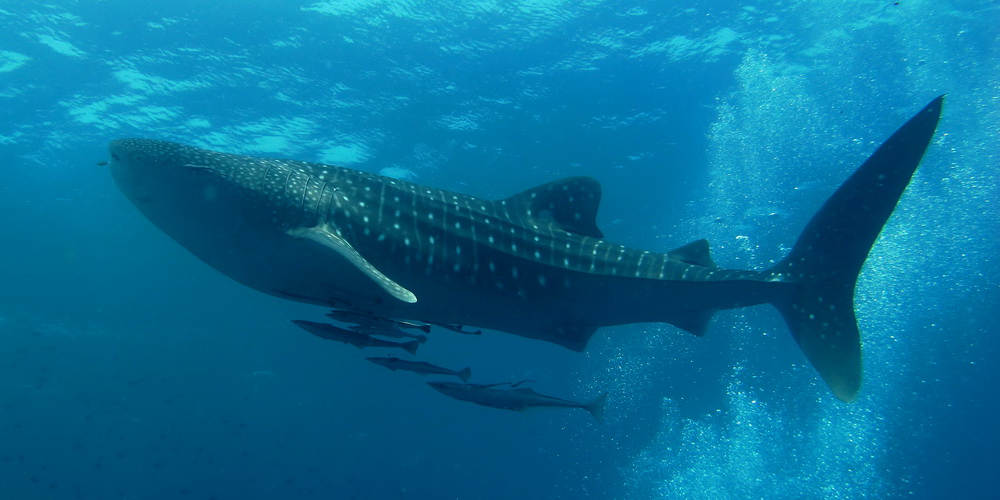
Whale Shark
Rhincodon typus
Photo: Wikimedia Commons (CC) via https://en.wikipedia.org/wiki/Whale_shark
Overview
The whale shark is the largest living fish, reaching lengths of up to 18 meters, though most individuals measured are smaller. Despite its size, it is a filter feeder, consuming plankton, small fish, and fish eggs by filtering large volumes of water through its gill rakers. Its body is grey to brown with a distinctive pattern of white spots and stripes, unique to each individual, which researchers use for photo-identification.
It is a slow-moving, generally solitary species, though aggregations form at seasonal feeding sites. As a filter feeder, it plays a role in transferring energy from planktonic production to higher trophic levels and may influence the distribution of prey species.
Whale sharks inhabit tropical and warm temperate waters worldwide, occupying oceanic, coastal, and neritic marine zones. They are highly migratory, undertaking long-distance movements across ocean basins, and are recorded in over 80 countries and territories, including Mozambique, Australia, Mexico, the Philippines, Indonesia, and the Maldives, among many others.
The species faces multiple ongoing threats: vessel strikes from shipping traffic, injury and disturbance from recreational tourism activities, entanglement in or ingestion of marine debris and garbage, oil and gas exploration and drilling activity in its habitats, and broader pollution and habitat alteration linked to coastal development and climate-driven shifts in oceanographic conditions.
Conservation efforts include international trade protections under CITES, national legal protections in numerous range states, regulation of tourism interactions at key aggregation sites, and satellite tagging and photo-identification programs to monitor movements and population trends.
The population is assessed as decreasing, and the species is classified as Endangered. Continued exposure to vessel strikes, bycatch, and habitat degradation suggests ongoing population pressure without significant intervention.
Whale sharks face serious risks from ship strikes along busy shipping routes and disturbance from tourists and boats during recreational encounters, as well as pollution from oil and gas drilling operations, floating garbage, and other waterborne waste. Their ocean habitats are also gradually changing due to broader environmental shifts, which can affect the food sources and migration patterns they depend on. These combined threats appear to be ongoing and stable rather than clearly worsening, though the wide range of pressures means continued monitoring is important.
Habitat
Conservation measures underway
Threatened in American Samoa
Frequently asked questions
Why is Whale Shark classified as Endangered?
Where does Whale Shark live?
What are the main threats to Whale Shark?
Get weekly conservation intelligence
One short digest a week of the most striking species and country data we ship, plus breaking conservation news paired with our database where it matters.
Free, no spam. One-click unsubscribe in every email.