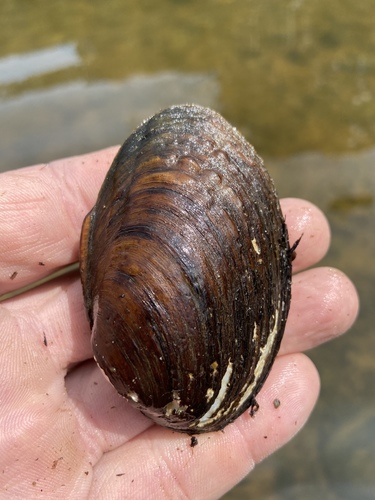
Warrior Pigtoe
Pleurobema rubellum
Photo: (c) Jesse Holifield, some rights reserved (CC BY-NC), uploaded by Jesse Holifield
Overview
Pleurobema rubellum, commonly known as the pyramid pigtoe, is a freshwater mussel species endemic to the southeastern United States. This bivalve mollusk historically inhabited river systems across Alabama, Georgia, and Tennessee, where it lived partially buried in sandy and gravelly substrates of flowing waters. The species plays an important ecological role as a filter feeder, helping to maintain water quality by removing particles and nutrients from the water column.
Like many freshwater mussels, the pyramid pigtoe has a complex life cycle that requires a fish host for its larval stage, making it dependent on healthy fish populations for reproduction. The species has experienced severe population declines due to habitat degradation, dam construction, water pollution, and sedimentation. River channelization and altered flow regimes have further compromised suitable habitat.
The construction of dams has fragmented populations and changed the natural flow patterns essential for the species' survival. Water quality degradation from agricultural runoff, urban development, and industrial activities has also contributed to population declines. Conservation efforts include habitat restoration projects, water quality monitoring, and research into propagation techniques.
Some populations are being monitored through surveys, and efforts are underway to better understand the species' host fish requirements. The pyramid pigtoe's critical conservation status reflects the broader crisis facing freshwater mussel diversity in North America, where these species represent some of the continent's most imperiled fauna.
The pyramid pigtoe faces severe threats from habitat destruction caused by dam construction, river channelization, and altered water flows. Water pollution from agricultural runoff, urban development, and industrial activities has degraded water quality in remaining habitats. Sedimentation from land use changes has buried suitable substrate and reduced water clarity essential for the species' survival.
Habitat
The pyramid pigtoe inhabits flowing freshwater rivers and streams with sandy to gravelly substrates. The species requires clean, well-oxygenated water with stable flow regimes and minimal sedimentation.
Other threatened species in UNIONIDAE

Threatened in United States
Frequently asked questions
Why is Warrior Pigtoe classified as Critically Endangered?
Where does Warrior Pigtoe live?
What are the main threats to Warrior Pigtoe?
Get weekly conservation intelligence
One short digest a week of the most striking species and country data we ship, plus breaking conservation news paired with our database where it matters.
Free, no spam. One-click unsubscribe in every email.