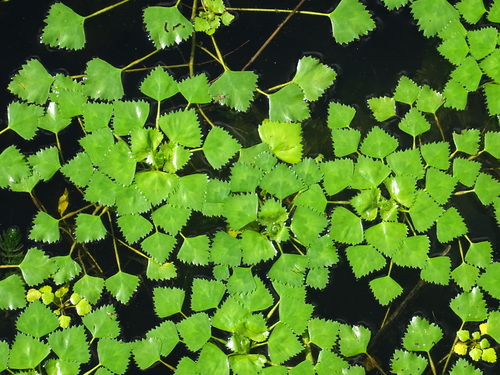
Colchis Water-Chestnut
Trapa colchica
Photo: Photo: (c) Daniela Hlavka, all rights reserved, uploaded by Daniela Hlavka
Overview
The Colchis water-chestnut (Trapa colchica) is a floating-leaved aquatic plant endemic to the Colchic lowlands of western Georgia and the adjacent Black Sea coastal region, a botanically distinctive relict of ancient Colchian wetland flora. It produces rosettes of rhombic, toothed floating leaves buoyed by inflated petioles, along with submerged, feather-like roots, and small white flowers that give rise to distinctive spiny nutlets, a genus trait shared with other water chestnuts. This species is classified as Critically Endangered (CR) by the IUCN, with a population trend that continues to decrease.
It survives in only a small number of shallow lakes, oxbows, and slow-moving freshwater bodies within its restricted Colchic range, habitats that have shrunk considerably due to drainage, land conversion, and water management schemes tied to agricultural and infrastructure development. Eutrophication and siltation from surrounding land use have further degraded the remaining water bodies, reducing suitable conditions for the species' floating rosettes and altering the shallow, nutrient-balanced waters it depends upon. Its narrow endemism and fragmented distribution leave remaining populations especially vulnerable to any localized disturbance, whether a drought, a pollution event, or further wetland conversion.
Encouragingly, Georgian botanists and regional conservation bodies have identified the species as a priority for wetland protection, and some of its known sites fall within areas recognized for broader biodiversity value, offering a foundation for targeted habitat safeguards. Continued monitoring of surviving populations, combined with wetland restoration efforts already underway in parts of the Colchic lowlands, provides a genuine, if fragile, pathway toward stabilizing this botanically significant species.
Trapa colchica faces severe population decline due to habitat destruction from wetland drainage and agricultural conversion throughout its native range in the Caucasus region. Water pollution from agricultural runoff and urban development has degraded remaining aquatic habitats, while climate change-induced alterations to precipitation patterns threaten the seasonal water levels this species requires for reproduction.
Habitat
Trapa colchica inhabits shallow freshwater lakes, ponds, and slow-moving rivers in the Caucasus region, typically growing in nutrient-rich waters with muddy substrates. The species requires specific seasonal water level fluctuations and prefers areas with partial shade from surrounding vegetation.
Conservation measures underway
Other threatened species in LYTHRACEAE
Frequently asked questions
Why is Colchis Water-Chestnut classified as Critically Endangered?
Where does Colchis Water-Chestnut live?
What are the main threats to Colchis Water-Chestnut?
Get weekly conservation intelligence
One short digest a week of the most striking species and country data we ship, plus breaking conservation news paired with our database where it matters.
Free, no spam. One-click unsubscribe in every email.