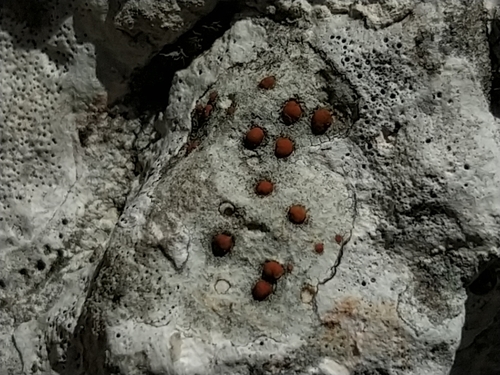
protoblastenia lichen
Protoblastenia calva
Photo: (c) Rémy Poncet, some rights reserved (CC BY-NC), uploaded by Rémy Poncet
Overview
Protoblastenia calva is a crustose lichen — a fungal-algal symbiosis that forms a thin, tightly adhered crust on rock surfaces rather than growing as a leafy or branching structure. Like other members of the Psoraceae, it consists of a fungal partner (mycobiont) housing photosynthetic algae, allowing it to derive energy while contributing to slow biological weathering of stone and playing a minor role in early-stage substrate development and nutrient cycling in exposed rocky habitats. It shows no active behavior beyond typical lichen growth patterns, expanding gradually over calcareous or basic rock surfaces in open, well-lit terrestrial environments.
The species has an unusually broad global distribution, recorded across much of Europe (from Scandinavia and the UK through Central Europe to the Mediterranean and Balkans), as well as in Russia, Turkey, Tunisia, Greenland, Svalbard, and outlying populations in the United States, Canada, Mexico, and Australia. It occupies exposed rock and stone substrates in terrestrial settings, often in areas with specific mineral and pH conditions.
Despite this wide range, the species is classified as Critically Endangered. Key pressures include atmospheric nitrogen deposition and air pollution, which alter substrate chemistry and harm sensitive lichen physiology; climate change affecting temperature and humidity regimes essential for growth; habitat loss from urban expansion and infrastructure development; degradation of suitable rock substrates; and direct human disturbance in occupied sites.
Population trend data remains unknown, complicating conservation planning. Current measures likely include habitat protection within designated conservation areas and ongoing lichen biodiversity monitoring in parts of its range, though species-specific interventions are limited. Given the combination of widespread but fragmented occurrence, multiple ongoing anthropogenic pressures, and insufficient population monitoring, the species' long-term trajectory remains uncertain and warrants continued surveillance.
Protoblastenia calva faces ongoing pressure from air pollution and excess nitrogen falling from the atmosphere, which changes the chemistry of the surfaces it grows on, while shifting temperature and humidity patterns from climate change are altering the conditions it depends on. It's also losing habitat as land is developed for buildings and infrastructure, and the rock or stone surfaces it needs are becoming less available or suitable, compounded by disturbance from human activity in the areas where it still survives. These threats appear to be ongoing and stable rather than clearly worsening, though continued monitoring would be needed to confirm this.
Habitat
This lichen species typically grows on calcareous rocks, concrete surfaces, and mortar in urban and semi-urban environments, particularly on walls, buildings, and other anthropogenic substrates. It requires specific pH conditions and is sensitive to air quality, thriving in areas with moderate pollution levels but declining when conditions become too extreme.
Other threatened species in Psoraceae
Threatened in Albania

Frequently asked questions
Why is protoblastenia lichen classified as Critically Endangered?
Where does protoblastenia lichen live?
What are the main threats to protoblastenia lichen?
Get weekly conservation intelligence
One short digest a week of the most striking species and country data we ship, plus breaking conservation news paired with our database where it matters.
Free, no spam. One-click unsubscribe in every email.