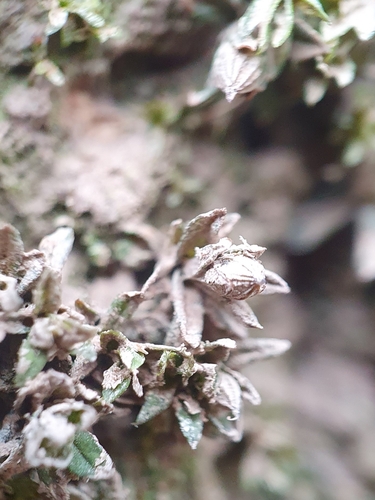
Spruce's Bristle-moss
CRCritically Endangered

Spruce's Bristle-moss

Orthotrichum sprucei

Conservation status data sourced from the IUCN Red List of Threatened Species.

Photo: no rights reserved, uploaded by Jonathan Hughes

01Classification

Taxonomy & Classification

Kingdom

Plantae

Phylum

Bryophyta

Class

Bryopsida

Order

Orthotrichales

Family

Orthotrichaceae

Genus

Orthotrichum

Spruce's Bristle-moss belongs to the family Orthotrichaceae, order Orthotrichales, within the Bryopsida class.

02Description

Species Profile

Species profile data sourced from the IUCN Red List of Threatened Species.

Spruce's Bristle-moss faces severe threats from habitat degradation and loss due to air pollution, particularly acid rain and nitrogen deposition, which alter the chemistry of its bark substrates. Climate change poses additional risks through altered precipitation patterns and temperature regimes that affect the delicate moisture balance required for this epiphytic moss. The species' extremely limited distribution and small population sizes make it highly vulnerable to local extinctions from environmental disturbances.

Key Facts

IUCN StatusCritically Endangered (CR)
GroupPlants
03Habitat

Habitat & Distribution

This epiphytic moss grows exclusively on the bark of deciduous trees, particularly in humid woodland environments and along stream valleys in temperate regions. It requires specific microclimate conditions with consistent moisture levels and clean air quality to survive on its tree host substrates.

04Threats

Threats

!

IUCN Red List: Critically Endangered

Spruce's Bristle-moss faces severe threats from habitat degradation and loss due to air pollution, particularly acid rain and nitrogen deposition, which alter the chemistry of its bark substrates. Climate change poses additional risks through altered precipitation patterns and temperature regimes that affect the delicate moisture balance required for this epiphytic moss. The species' extremely limited distribution and small population sizes make it highly vulnerable to local extinctions from environmental disturbances.

Air pollution and acid deposition

HighOngoing

Climate change and altered precipitation patterns

HighOngoing

Habitat fragmentation and forest degradation

HighOngoing

Limited distribution and small population size

HighOngoing

Loss of suitable host trees

MediumOngoing
07National Status

National vs Global Threat Status

How this species is assessed at the national level compared to its IUCN global status (CR).

CountryNational StatusGlobal StatusComparison
EULCLeast ConcernCRCritically EndangeredLower local risk

National Red List data sourced from the National Red List Project (nationalredlist.org, ZSL) and country-specific Red List authorities.

Community

Community Sightings

Report a sighting

No community sightings yet. Be the first to report!

07Sources

Sources & Attribution

How to Cite

IUCN: IUCN (2025). The IUCN Red List of Threatened Species. Version 2025-1. Available at: https://www.iucnredlist.org. doi:10.2305/IUCN.UK.2025-1.RLTS

GBIF: GBIF.org (2025). GBIF Home Page. Available at: https://www.gbif.org

National Red Lists: ZSL (2025). National Red List. Zoological Society of London. Available at: https://www.nationalredlist.org

This page: SpeciesRadar (2025). Spruce's Bristle-moss (Orthotrichum sprucei). SpeciesRadar: Intelligence for Earth's Biodiversity. Available at: https://speciesradar.org/species/spruces-bristle-moss

Full citation guide & data usage terms